
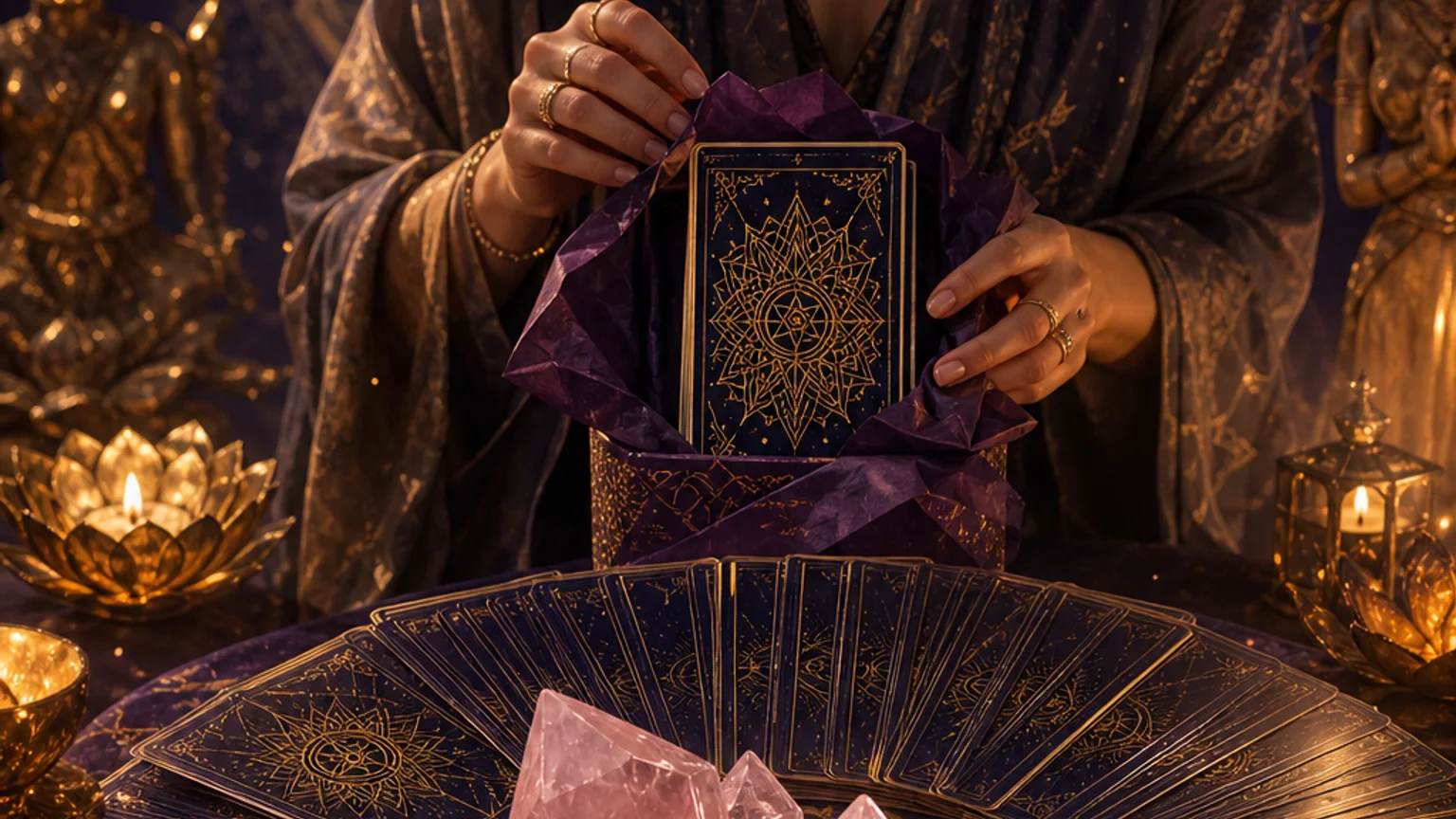
Choosing Your First Tarot Deck: A Beginner’s Guide with Crystals
Choosing Your First Tarot Deck: A Beginner’s Guide with Crystals
There’s a strange myth that your first tarot deck has to be a gift, that you shouldn’t buy your own, and that breaking this rule somehow curses the cards. None of that is true. What is true — and far more useful — is that the deck you start with shapes how fast you learn, and that the small ritual of “meeting” a new deck (often called opening or dedicating it) sets the tone for how you’ll work together. This guide walks through both: how to choose your first deck, and what to actually do in the first hour after you open it, with a small crystal companion woven through the opening ritual that becomes your long-term touchstone with this deck.
Why the First Deck Trips Up Beginners
Three things tend to confuse people at this step.
First, the “must be gifted” myth stops perfectly good readers from buying a deck they actually want — and the myth has no historical basis. Second, beginners often choose by aesthetic alone without realizing that some beautiful decks use non-standard symbolism that’s hard to learn from as a first deck. Third, even once they have the deck, they skip the opening ritual — going through the cards, cleansing, doing an “interview spread” — and miss the small moment that turns a stack of cardboard into a working tool they have a relationship with.
The walkthrough below addresses all three. The crystals woven through the opening ritual aren’t there to “charge the deck’s energy” — they’re tactile companions at the steps where your attention is most likely to skip past. One of those stones becomes a long-term touchstone you keep with the deck.
Choosing and Opening Your First Tarot Deck: A Seven-Step Walkthrough
Step 1 — Pick the Right Tradition (RWS First)
For a first deck, choose a Rider-Waite-Smith (RWS) tradition deck. RWS is the system almost all beginner books and most tarot websites reference, so the imagery you learn will match the resources you read. Thoth and Marseille traditions are beautiful but harder for beginners because their symbolism is more abstract. Within RWS, you have dozens of variations — the original Rider-Waite, the Radiant Rider-Waite, the Smith-Waite — all using the same underlying symbol system.
Step 2 — Choose by Aesthetic Pull, Not “Should”
Within RWS-tradition, pick the deck whose art genuinely pulls you. You’ll spend many hours with these images; choosing a deck you find beautiful makes study feel like a pleasure, not a chore. The pull you feel toward certain art is information — follow it, within the RWS-tradition guardrail from Step 1.
Step 3 — Forget the “Must Be Gifted” Myth
The idea that your first deck must be a gift is folklore, not a rule. Many of the most skilled readers alive bought their own first deck. What matters is that the deck resonates with you — and you’re the best judge of that, whether the deck came from a store, a friend, or an inheritance. Anyone who tells you a self-purchased deck is “less authentic” is repeating a myth that has quietly blocked too many beginners.
Step 4 — Go Through Every Card
When you open the deck, go through all 78 cards one by one. Don’t skip; don’t rush. This is the “meeting” pass — you’re introducing yourself to the deck as much as the cards to you. Let yourself react to each image freely: which cards draw you, which make you flinch, which feel boring. These first reactions are data; you’ll come back to them later. A gentle “meet without judgment” anchor at this step helps you stay open rather than evaluating.
Step 5 — Cleanse the Deck
Cleansing is a small ritual of attention — a physical gesture that signals this is a new chapter. It’s not because the deck has “bad energy” (it doesn’t), and it’s not because the cards need to be “purified.” It’s because you, the reader, are marking a beginning. See our how to cleanse tarot cards guide for the full range of methods (smoke, moonlight, breath, sound, salt) and which work best for which situation.
Step 6 — Interview Your Deck
Do a short “interview spread” with the new deck — usually five to seven questions like “What are your strengths?”, “What kind of readings are you best suited for?”, “How can I work with you most effectively?”, “What will you teach me?”, “What do you ask of me?” Draw one card per question. The results are often surprisingly apt, and they give you a sense of the deck’s “voice” — which cards it tends to favor, how literal or poetic its answers feel. An “inward listening” anchor at this step helps you receive the answers rather than analyzing them.
Step 7 — Choose a Touchstone Stone
At the close of the opening ritual, choose one of the stones you’ve used (or a new one) to keep with the deck as its long-term touchstone. This isn’t required — but having a small physical companion that lives with the deck gives you a tactile “hello” each time you take the deck out, and over time the stone becomes a small sensory anchor for the practice itself.
Crystals as Tactile Anchors for the Opening Ritual
The crystals below are not magic. They’re small tactile companions at the steps where your attention is most likely to skip past the ritual. Each one is matched to the kind of attention that step asks for. One of them — you choose which — becomes your long-term touchstone with this deck.
Step 4 — Rose Quartz (Meeting the Cards)
Set rose quartz beside the deck as you flip through all 78 cards for the first time. Rose quartz’s traditional association with warmth is used here as: a “meet without judgment” anchor — a soft reminder that this is a meeting, not an evaluation. If a card makes you flinch, the feel of the stone is a small prompt to stay open and notice your reaction rather than closing around it.
Step 5 — Selenite (Cleansing)
Rest the deck on a selenite wand or plate for a few minutes as your cleansing gesture (or pass the deck over selenite if you prefer). Selenite is a tactile “fresh start” cue — a physical gesture of new chapter, not a “purification of bad energy.” The stone’s traditional association with clarity is used here as: a small ritual that signals to your body that the deck is being welcomed, not just unpacked. For the full set of cleansing methods, see our how to cleanse tarot cards guide.
Step 6 — Amethyst (Interviewing)
Hold amethyst during the interview spread. Amethyst’s traditional association with reflection is used here as: an “inward listening” anchor — a small weight in your hand that reminds you to receive the cards’ answers rather than analyzing them too quickly. The interview spread works best when you let the cards answer; amethyst in your palm is a small prompt to listen before you interpret.
An Eastern Lens on Choosing and Opening a Deck
The choice and opening of a first deck maps onto a non-mystified reading of two Eastern concepts: 结缘 (forming a karmic connection) and 开光 (awakening a sacred object).
- 结缘 (Forming Connection) — Steps 1 through 3. Choosing the deck is forming a connection, not acquiring a possession. In the Buddhist sense, “forming a connection” simply means establishing a relationship that will unfold over time. The “must be gifted” myth misunderstands this — the connection forms through your resonance with the deck, not through how it arrived.
- 开光 (Awakening) — Steps 4 through 6. The opening ritual is a non-mystified “awakening.” In serious Tibetan Buddhist practice, 开光 of a sacred object isn’t magic performed on the object — it’s a deliberate ritual of attention by the practitioner that establishes how the object will be used. Going through the cards, cleansing, and interviewing your deck is exactly this: you’re not “charging” the deck, you’re telling yourself clearly this is a tool I will use with care.
In this framing, the ritual is for the practitioner, not the deck. The deck doesn’t need opening; you do. The crystals at each step (rose quartz for meeting, selenite for marking the new chapter, amethyst for listening) are tactile reminders that the work is yours.
Common Mistakes Beginners Make with a First Deck
Believing the “gifted deck” myth. If you want a deck, buy one. The deck you actually resonate with beats the deck someone else chose for you, every time. Anyone who insists otherwise is repeating folklore.
Choosing a non-RWS deck as a first deck. Thoth, Marseille, and many oracle decks are beautiful but use different symbol systems that make learning from beginner resources much harder. Start with RWS-tradition; branch out after you’re comfortable.
Skipping the “go through every card” step. It’s tempting to open the deck and immediately start doing readings. Resist. Going through all 78 cards is a 20-minute investment that pays off for years — you’ll know the deck’s voice, its visual quirks, and your own initial reactions to each card.
Cleansing with direct salt. Salt damages cards. If you use salt as a cleansing method, put it in a small bowl near the deck inside an airtight container — never sprinkle salt directly on the cards. See our how to cleanse tarot cards guide for the safe version of this method.
Skipping the interview spread. The interview spread takes ten minutes and gives you a feel for the deck that would otherwise take weeks to develop. Skip it and you’ll spend the first month wondering if a card that often shows up is “this deck’s thing” or just chance. The interview answers that question up front.
FAQ
Does my first tarot deck have to be a gift?
No. The “must be gifted” rule is folklore with no historical basis. Most working tarot readers today bought their own first deck. What matters is that you resonate with the deck — and you’re the best judge of that, regardless of how the deck arrives.
What’s the best first tarot deck for a complete beginner?
A Rider-Waite-Smith (RWS) tradition deck. The original Rider-Waite, the Radiant Rider-Waite, and the Smith-Waite Centennial are all excellent choices within RWS. The reason is practical: nearly all beginner books and most tarot websites reference RWS imagery, so the cards you learn will match the resources you read. Avoid Thoth and Marseille as first decks.
What do I do first when I open a new tarot deck?
Go through all 78 cards one by one — this is the meeting pass, not a study session. Then do a small cleansing gesture (selenite, smoke, moonlight, or simply a few conscious breaths — see our cleansing guide). Then do an interview spread of five to seven questions. After that, you’re ready for daily pulls.
Can I have more than one tarot deck?
Yes — eventually. In the first three months, sticking with one deck accelerates learning because you build a relationship with one set of images. After that, branching out is a pleasure rather than a confusion. Many long-time readers have several decks, each used for different kinds of questions.
Ready to open your deck with the crystals in hand? Rose Quartz for the meeting pass, Selenite for the cleansing gesture, and Amethyst for the interview spread form a small three-stone opening set — and one of them becomes your long-term touchstone with the deck. You can browse rose quartz pieces here, find selenite here, of explore the full crystal collection if you’d like to wear your touchstone.
Related guides to explore next: tarot for beginners for the broader starting path, how to cleanse tarot cards for the full cleansing methods, how to shuffle tarot cards for shuffle techniques, storing tarot cards for keeping your deck safe, and tarot card meanings list as your 78-card reference.