Death and The Tower at a Glance
Death and The Tower at a Glance
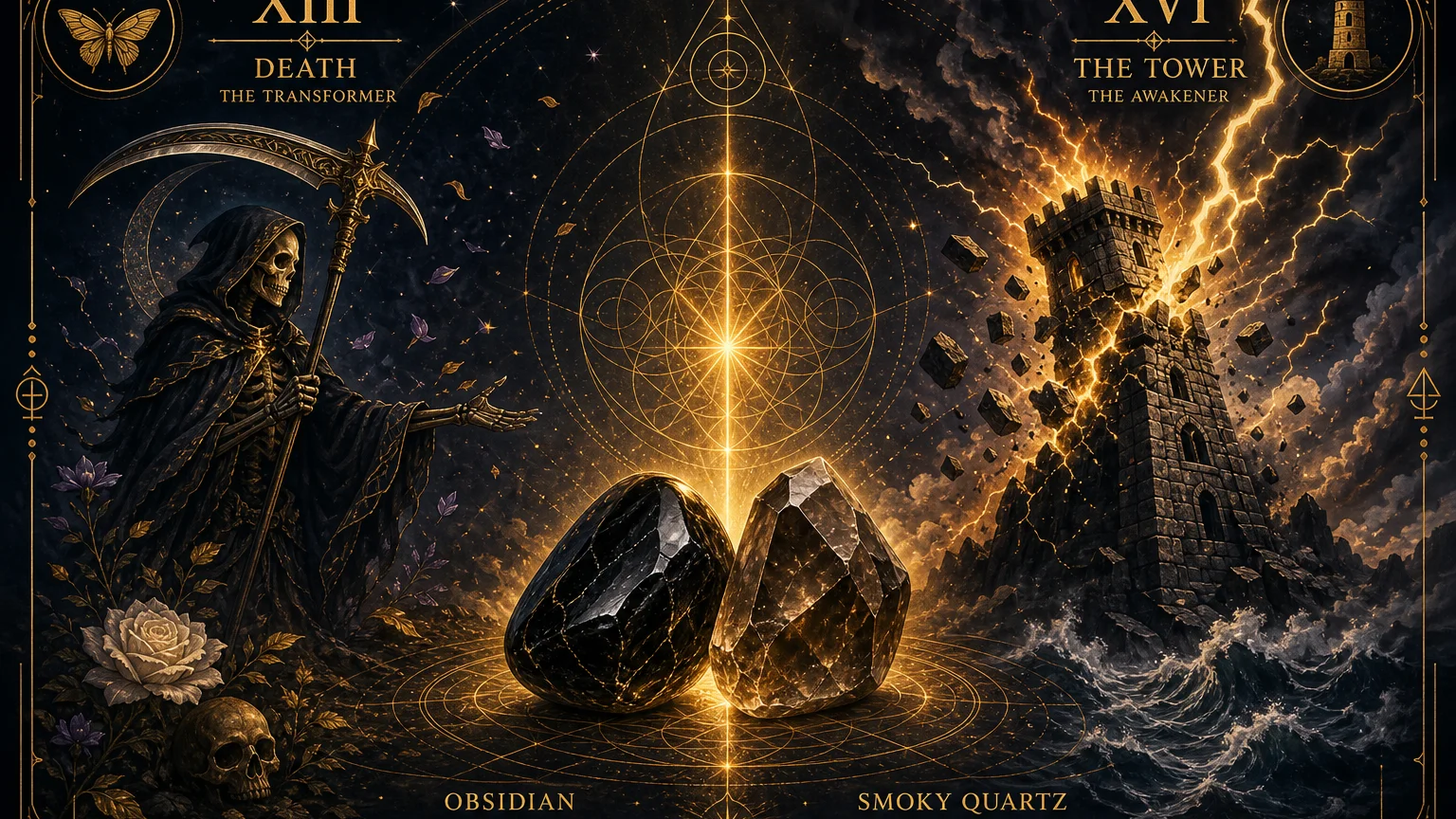
When Death and The Tower appear together in a reading, the message is one of amplified structural ending — two archetypes of finish resonating at the same time. Death (Water) is the slow, necessary close of something already completed; The Tower (Fire) is the sudden, lightning-fast collapse of something already unstable. Together they describe a season in which what was ending gradually is forced into the open, and the clearing that follows is total.
Crystals: Obsidian (Death’s truth-mirror for the gradual end) + Smoky Quartz (The Tower’s grounding through collapse). Read the synergy in M6.
In one line: this is not “disaster times two” — it is one ending, felt in two registers: the inevitability you’ve been quietly walking toward, and the break that names it out loud.
The Two Cards: Quick Recap
Death — the Transformer (Water, Scorpio). In its relevant register here, Death is the archetype of gradual, necessary ending: the slow transformation that clears what has already completed. A skeleton in armor rides a pale horse, a bishop pleading, a fallen king before it, and a child watching with curiosity — almost everyone reads the same closing differently. The card is rarely literal; it points to release, to the doorway that opens only when you let an old form of life close. What matters for this combination is Death’s patience — its sense that the ending was already underway before the card ever appeared.
The Tower — the Awakener (Fire, Mars). In the register that matters here, The Tower is sudden collapse of a structure that was already unsound — a tall tower struck by lightning, two figures falling, a crown knocked from its top. It is the truth that arrives in a flash, revealing that the foundation underneath was never as solid as it looked. The card does not invent the instability; it exposes what was already structurally compromised. The crown falling from the tower top is the emblem: authority built on shaky ground, brought down by the thing it was always vulnerable to.
What Death and The Tower Mean Together
(Structure variant V2: the two cards’ Rider-Waite imagery colliding. Structure variant V5: the crystal synergy woven into the story.)
Picture the two cards laid side by side. On the left, Death’s pale horse moves across the field at a walker’s pace — armored skeleton upright, sun rising between two distant towers on the horizon, a bishop pleading at its hoof, a fallen king already on the ground. On the right, the Tower is mid-collapse — the bolt has already struck, the crown is spinning off the top, two small figures are falling, and the sky is on fire. Read together, the images do something they cannot do alone: the lightning in the Tower lights up the field Death is already crossing. What was going to end slowly is suddenly visible. What was going to fall anyway is falling now.
This is the chemistry the combination is built on — not “one ending plus another ending,” but two forms of structural finish amplifying each other into a single felt event. Death’s contribution is the inevitability: the thing was already completed, the transformation already underway, the bishop’s pleading was never going to change the horse’s direction. The Tower’s contribution is the velocity and exposure: the bolt that names the rot out loud, the crown stripped from the top, the collapse that can no longer be carried privately. Put them together and you get the signature feeling of this pair — what was ending anyway is forced into the open. The slow close and the sudden break are not two endings; they are the same ending heard in two registers, one bass and one thunder.
There is a real tension in which one leads. When Death’s pace sets the rhythm, the Tower’s bolt is read as the moment the gradual end became undeniable — the structure was already emptying, the lightning just made the emptiness loud. When the Tower leads, Death arrives as the truth that this was never a repair job: the collapse was not an accident to be reversed but a clearing to be accepted, and the pale horse was already on its way before the bolt ever fell. Either way, the combination refuses the reading that the fall was random. It insists, gently and firmly, that the foundation was the issue all along.
This is why the pair amplifies rather than merely adds. Death without the Tower can be honored quietly — a private grief, a slow release, a chapter closed at one’s own pace. The Tower without Death can be read as pure accident — bad luck, external shock, something to be fixed and rebuilt identically. But together, the two cards foreclose both escapes: you cannot grieve this privately (the Tower has exposed it), and you cannot pretend it was an accident (Death names it as completion). What is left is the harder, truer work: acknowledging that something structural has finished, and that the rebuild must happen on foundations that are now actually true.
Here the crystal pair does its specific work — Obsidiana (Death’s truth-mirror) keeps you honest about the close you’ve been avoiding, while Smoky Quartz (The Tower’s grounding stone) keeps you upright when that close arrives with force. One stone for the what — naming the end without flinching — one for the how — staying rooted while the structure falls — so that an ending amplified by two cards does not become free-fall. (The full synergy is detailed in M6 below.)
It is worth naming the fear this combination surfaces, because the fear is the point. Two “ending” cards together trigger the catastrophizing reading — everything is falling apart at once. The combination’s actual instruction is almost the opposite. Yes, the ending is real and large. But because it is structural (a form that completed) rather than random (a bolt out of a clear sky), it is also navigable. The pale horse was already walking. The tower was already unsound. What the combination offers, once the panic settles, is the strange relief of a thing finally being named — the ground that is now true, because the false ground is finally gone.
Death and The Tower in a Spread
The same two cards read differently depending on where they fall in a spread, because their time signatures differ — Death is gradual, the Tower is instant.
| Position pairing | How it reads | |—|—| | **Death in the past + Tower in the present** | A slow ending you’ve been carrying privately is now erupting into the open. The structure was already emptying; the bolt just exposed it. The work now is to stop patching and start clearing honestly. | | **Tower in the past + Death in the present** | The sudden break already happened (a shock, a disclosure, a collapse); Death now names it as *completion, not accident* — what fell was finished, and what remains is the slow work of accepting the close. | | **Both in the present** | Two endings overlapping in real time: a gradual close and a sudden break happening together. The signal is *total clearing* — do not split your attention trying to save one structure while the other falls. |The pair does not have a single fixed reading; its meaning is set by which card carries the “already happened” weight and which carries the “happening now” weight. In any position, the instruction converges on the same thing: accept the structural end, and begin the rebuild on truer ground.
Are Death and The Tower a Yes or No?
This is a conditional no, leaning strongly negative for questions that ask “should I keep going / hold on / preserve this as it is?” — the pair answers by clearing, not by sustaining. For questions of the form “is it time to let this end?” or “should I rebuild rather than repair?”, the same energy reads as a yes — permission to release what has already completed.
The nuance: this is never a “no” of punishment or random loss. It is a “no” of structural truth — the answer is no precisely because the thing being asked about has already finished, and the cards are naming it. For a deeper treatment of the yes/no logic on each card, see the dedicated Death and Tower pages.
Crystals for the Death–Tower Combination
The crystal synergy for this pair is not two stones listed in parallel; it is a single distributed response to amplified ending.
Obsidian — for Death’s gradual end. Obsidian is the stone of truth, release, and shadow work, used across Mesoamerican and Eastern traditions for unflinching honesty about what must end. For Death’s register in this pair, it serves as the mirror that lets you look at the structure that has already completed — the relationship, the role, the version of the plan — without flinching or bargaining. Use it as a reminder to name what is finished, rather than a tool that does the ending for you.
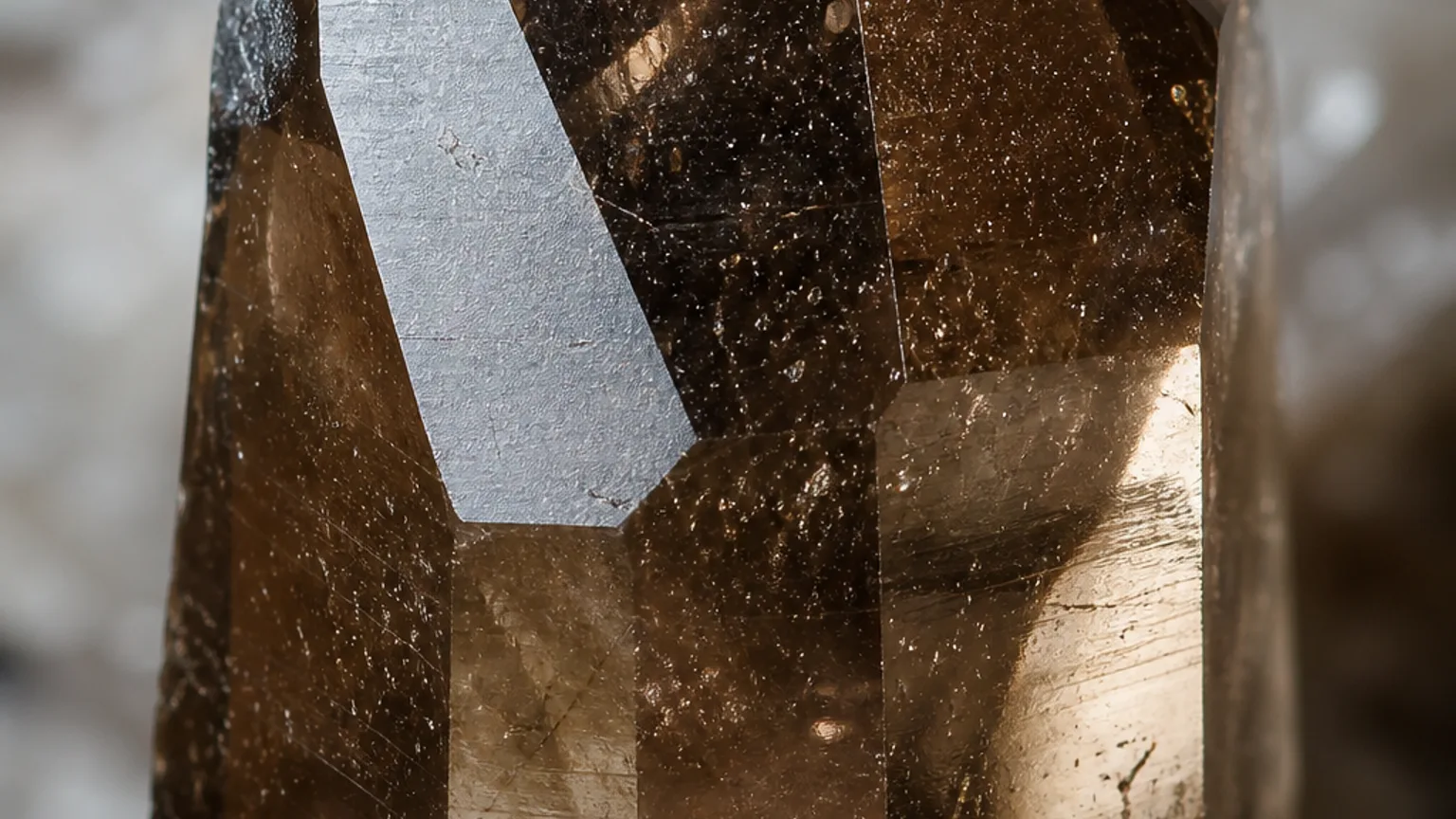
Smoky Quartz — for The Tower’s sudden collapse. Smoky Quartz is the stone of grounding through upheaval and gentle transformation, the steady companion for the moment the familiar structure falls. For the Tower’s register here, it supports landing in the body when the bolt has struck — staying present and rooted while the dust settles, rather than dissolving into the catastrophizing the pair can trigger. Carry it as a tactile cue to stay grounded, not as a shield that prevents the collapse.
How they work together. Obsidian handles the what (the honest naming of the end), Smoky Quartz handles the how (staying rooted as it falls). The synergy is “face it honestly, stand through it steadily” — so that an ending amplified by two cards does not become free-fall. Neither stone promises to remove the ending; both support you in moving through it with eyes open and feet on the ground. (Obsidian meaning · Smoky Quartz meaning)
Death and The Tower in the Eastern Tradition
In the Eastern lens, this pair is a study of two forms of impermanence moving at different speeds. Death resonates with 无常 as the gradual, contemplated recognition that nothing is held as permanent — the quiet clearing that frees you to live fully because you have stopped gripping. The Tower resonates with the same impermanence as structural collapse-as-clarity: the false falling away to reveal what was always underneath, the built form proving its own emptiness.
Read together, the pair describes the 化与破 (gradual transformation and sudden break) operating in the same season — the slow emptying that Death honors and the lightning-fast exposure that the Tower brings. Eastern thought does not separate these: the gradual end and the sudden break are two faces of the same truth about conditioned forms. The instruction is not to resist either register, but to recognize that what is emptying was always emptying — and that the bolt, however shocking, is the clarity arriving on time.
FAQ & Related Combinations
Is Death + The Tower a disaster reading?
No — though it often triggers that fear. This pair names structural completion amplified, not random catastrophe. The ending was already underway (Death) and the structure was already unsound (Tower). The cards do not invent the fall; they expose it. The instruction is to accept the clearing and rebuild on truer ground, not to brace against an arbitrary blow.
Death and The Tower in love — what does it mean?
In a relationship reading, the pair usually points to a connection whose underlying structure has already completed — and that completion is now being made undeniable. It can mark a break that was a long time coming, or the disclosure that names what was already true. It is not a “stay and fix it” reading; it is a “face what has actually ended” reading. Rose Quartz can support grieving the close with heart rather than forcing it to stay.
How is this different from Death alone or Tower alone?
Death alone allows a slow, private honoring of an ending. Tower alone can be read as accident. Together they foreclose both escapes: the ending is exposed (Tower) and named as completion, not accident (Death). The combination is more total and more honest than either card on its own.
If it touches money or health, what’s the boundary?
For finances, this combination is read as a review signal — reassess what is structurally exposed, what foundation is unsound, what you are holding past its completion — not a prediction of loss or ruin. For health, it points to reflection and renewal, never to cure or recovery outcomes. The cards describe how you relate to change, not medical or financial results. See our gentle note below before acting on any reading.
Related pairings. The natural counterweight is Death and The Star — the same Death, met by hope and renewal after the clearing (causal, the “what fills the space” to this pair’s “what ends”). For the Tower’s rebuilding energy tempered by patience, Strength and The Tower shows the transformation where steady inner force meets sudden collapse. Browse all Tarot combinations on the hub.
A Gentle Note
Tarot readings are offered for reflection, not as prediction, medical advice, or financial guidance. No card combination — including one as heavy as Death with The Tower — predicts illness, loss, or specific outcomes. If a reading touches on money, health, or a significant life decision, please treat it as a prompt for honest self-review, and consult a qualified professional for anything that needs qualified care.
Crystals Referenced in This Reading