Best Crystals for Water Energy: Meaning, Uses & Zodiac Signs
Quick Answer: Best Crystals for the Water Element
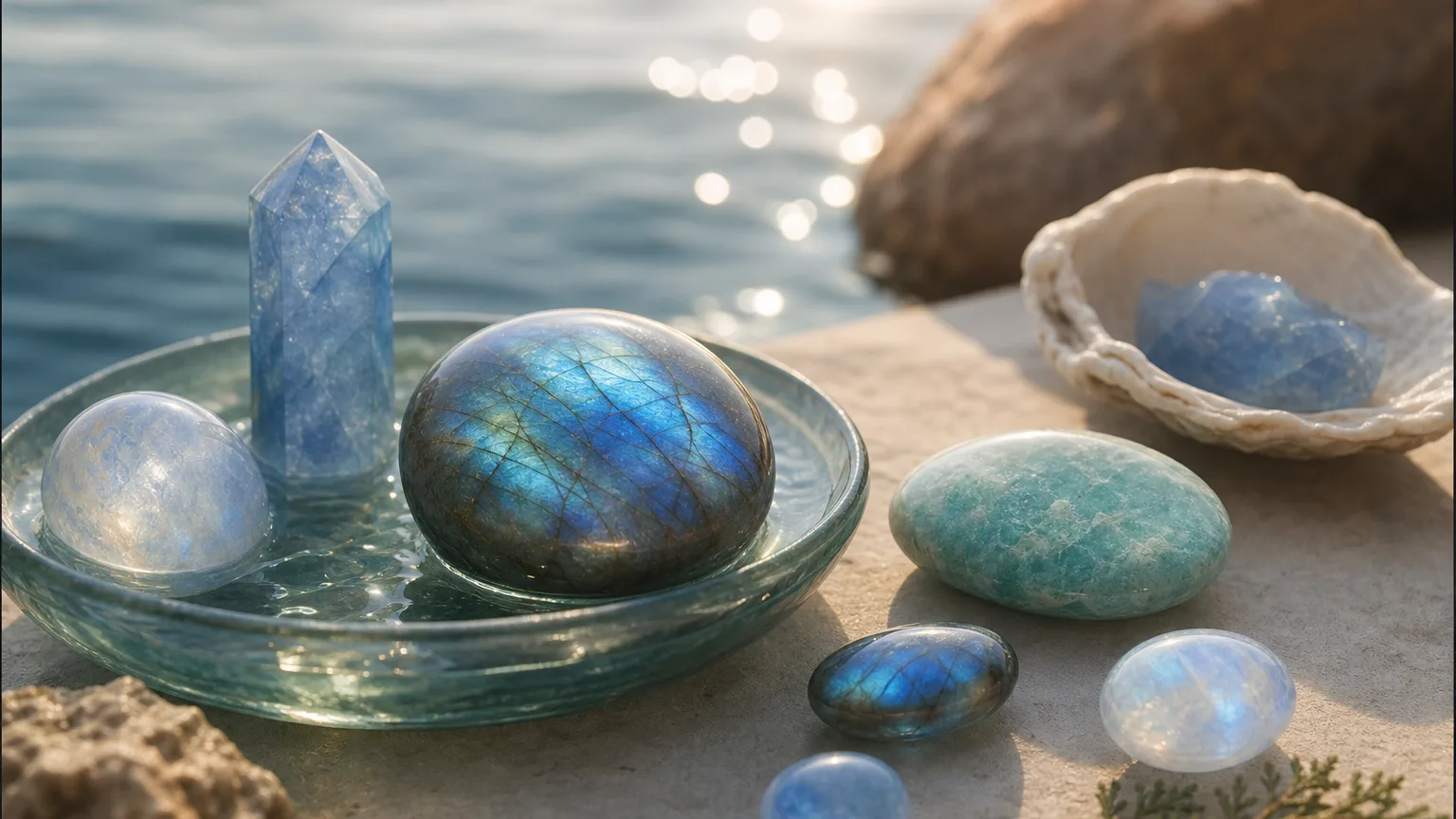
The best crystals for the Water Element include Labradorite, Moonstone, Amazonite, traditionally used in mindfulness and spiritual practices. Crystal properties are complementary wellness tools, not medical treatments.
Understanding the Water Element
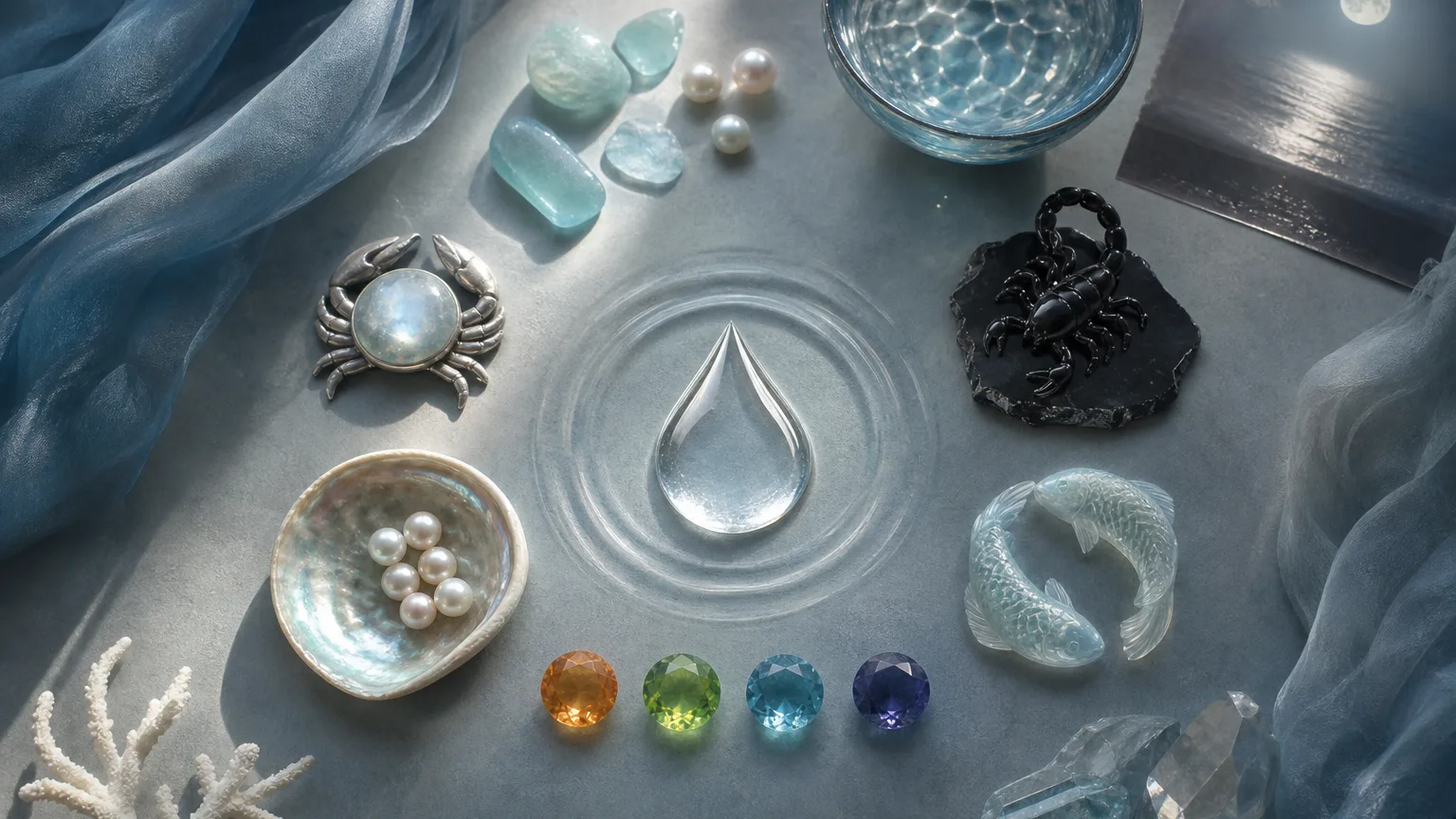
Of the four classical elements — Earth, Water, Air and Fire — Water is the one we most often reach for when life feels rigid or rushed. It is the element associated with feeling, intuition, adaptability and healing. Where Earth asks us to be steady and Fire asks us to act, Water asks us to soften: to notice what we feel, to let things move, to trust the slower knowing underneath the noise.
That quality shows up in nature in obvious ways. Water is the only element that takes the shape of whatever holds it — pooling, flowing, freezing, evaporating, returning. Ancient Greek, Chinese, Indian and Indigenous traditions all placed water at the centre of cleansing, dreaming and emotional life. Across cultures, rivers, tides and rain were treated as living forces that washed away what no longer belonged and carried new life downstream.
Modern psychology uses similar language. We talk about feelings as something that rise, swell, overflow or run dry. When someone is described as adaptable or emotionally fluent, that is water-shaped language. Working with the Water element in a mindfulness sense is less about adding something new and more about removing the blocks — the held breath, the braced shoulders, the story that you should not feel what you feel — so that what is already there can move again.
Crystals tied to Water tend to share a few features: cool blues and greens, milky or watery optical effects, and a softer internal light rather than a hard sparkle. Holding one can be a simple physical cue to slow down, the way a smooth pebble in the pocket reminds you to breathe. None of this is medical treatment for mood conditions, but as part of self-care it can help mark the difference between a reactive day and a considered one.
Quick facts: Traits: Emotion, intuition, healing, flow. Balanced: Empathetic, intuitive, adaptable. Out of balance: Overwhelm, mood swings, clinging. Western zodiac: Cancer, Scorpio, Pisces. Feng Shui: North, career/life path area.
Not sure if your Water is balanced? Take the Element Test ↗
12 Best Crystals for the Water Element
Labradorite
Element: Water
Elemental link: A feldspar mineral (calcium-sodium aluminosilicate) whose internal lattice layers scatter light into blue, gold and green flashes — a phenomenon called labradorescence that reads like light moving through deep water.
Element action: Channels Water energy toward intuition and adaptation during change
Color: Grey-black body with blue/gold/green flash
Chakra: Throat, Third Eye
Zodiac: Leo, Sagittarius
Best for: Change, Intuition, Creativity
Best way to use: Wear as jewelry
Affirmation: I trust the unseen current of my own knowing.
A plagioclase feldspar, labradorite forms in layered internal structures that bend light into the shifting blue-gold sheen known as labradorescence — the same optical trick that makes a shallow sea change colour as you move. Cool and smooth in the hand, it carries the quiet weight of a river stone. Traditionally associated with the Throat and Third Eye centres, it is often used as a companion for times of transition, when old patterns are dissolving and new ones have not yet settled. Many people hold it during reflection to meet change with curiosity rather than resistance, using its play of colour as a focus point for slower, steadier breathing.
Read full Labradorite meaning →
Moonstone
Element: Water
Elemental link: A feldspar of intergrown albite and orthoclase layers whose adularescence produces a soft billowing light — an optical echo of moonlight on water.
Element action: Balances Water energy through cycles, tides and emotional rhythm
Color: White/cream with blue-white sheen
Chakra: Third Eye, Crown, Sacral
Zodiac: Cancer
Best for: Intuition, Emotional balance, June birthstone
Best way to use: Wear as jewelry
Affirmation: I move with my own tides, not against them.
Moonstone is built from thin feldspar layers that scatter light into a floating blue-white glow called adularescence — the same gentle shimmer as moonlight traced on a still lake. Its surface is milky and cool, almost soft to the eye. Long linked with lunar cycles and the Sacral and Third Eye centres, it is often used as a touchstone for emotional rhythm, particularly through hormonal or seasonal shifts. In a mindfulness sense it is a reminder that feeling, like the tide, rises and falls on its own schedule; many wear it to mark a quiet nightly check-in, sitting with the stone for a few breaths and simply naming what is present without fixing it.
Amazonite
Element: Water
Elemental link: A microcline feldspar coloured blue-green by trace lead and water in its crystal structure, with a colour range that mirrors a tropical river over stone.
Element action: Balances Water energy by easing honest, calm expression
Color: Blue-green, turquoise-green
Chakra: Heart, Throat
Zodiac: Virgo, Aquarius
Best for: Communication, Calm, Honesty
Best way to use: Wear as jewelry
Affirmation: I speak what is true for me, gently and clearly.
A microcline feldspar, amazonite owes its blue-green to trace lead and structural water caught during formation — a literal pocket of the Water element held inside the stone. It has a cool, glassy feel and a colour somewhere between a clean river and shallow sea. Traditionally associated with the Heart and Throat, it is often used as a steadying companion before hard conversations, when feelings need to be named without flooding the room. As a mindfulness cue it invites self-honesty: held in the palm while you breathe, it can stand for the small commitment to say what is actually true, kindly, rather than what feels safest in the moment.
Opal
Element: Water
Elemental link: A hydrated silica (SiO₂·nH₂O) containing up to 20% water, whose tiny silica spheres diffract light into rainbow play-of-colour — water and light made visible.
Element action: Amplifies Water energy for feeling, imagination and renewal
Color: White, black, fire — rainbow play-of-color
Chakra: All
Zodiac: Libra
Best for: Creativity, Inspiration, October birthstone
Best way to use: Wear, carry, or place in your space
Affirmation: I let my feelings move and colour returns.
Opal is one of the few gems that is genuinely wet — a hydrated form of silica (SiO₂·nH₂O) carrying up to a fifth of its weight in water, locked in as it formed. Its play-of-colour comes from microscopic silica spheres stacked so regularly that they bend light into spectral flashes, like sunlight hitting a film of water. Smooth and slightly cool, it has a living, shifting surface. Long linked with inspiration and emotional release across many cultures, opal is often used as a focus for creative or reflective practice. As a self-care object it asks for tenderness — opals can dry out and crack, so they need occasional care, a quiet reminder that sensitive things (and people) soften and last longer when they are not pushed past their limits.
Larimar
Element: Water
Elemental link: A rare blue pectolite coloured by copper, found only in the Dominican Republic, whose patterns echo sunlight through shallow Caribbean water.
Element action: Calms Water energy that has become turbulent or overwrought
Color: Blue, White
Chakra: Throat, Heart
Zodiac: Leo, Pisces
Best for: Calm, Emotional balance, Communication
Best way to use: Wear as jewelry
Affirmation: I exhale, and the water inside me settles.
Larimar is a blue variety of pectolite, its colour coming from copper substituted into the crystal lattice, and it is found in only one small region of the Dominican Republic — a stone that quite literally comes from a Caribbean shoreline. Its white veining across blue looks like foam over shallow water, and it is cool and softly polished in the hand. Traditionally associated with the Throat and Heart, it is often used as a calming companion for stress and overthinking, especially when feelings have built up faster than they can be spoken. Held during slow breathing, it can serve as a physical cue to lengthen the exhale, the way you might steady a shaken glass of water by simply setting it down and waiting.
abalone-shell
Element: Water
Elemental link: The nacreous inner shell of a marine mollusc, whose layered aragonite plates diffract light into iridescent blues and greens — a structure grown entirely in seawater.
Element action: Grounds Water energy through emotional protection and ocean connection
Color: Iridescent blue, green, violet
Chakra: Throat, Heart, Third Eye
Zodiac: Aquarius, Pisces, Cancer
Best for: Calming, Emotional balance, Ocean connection
Best way to use: Wear as jewelry
Affirmation: I am held, even in deep water.
Abalone shell is the iridescent nacre that lines the inside of a marine mollusc — built up over years from microscopic aragonite tiles glued together with protein, the same layered structure that gives pearls their shimmer, grown entirely in the sea. Its surface flashes blue, green and violet as you turn it, smooth and shell-cool to touch. Many coastal cultures have treated it as a vessel for cleansing, burning herbs or holding small ritual objects in its curve. As a mindfulness object it carries a quiet ocean symbolism: a reminder that something soft once built this hard, beautiful protection around itself, and that caring for your own interior can be a slow, layered act rather than a single effort.
Read full abalone-shell meaning →
afghanite
Element: Water
Elemental link: A rare sodium-calcium aluminosulphate silicate, often found alongside lazurite in lapis deposits, with a deep watery blue that seems lit from within.
Element action: Channels Water energy toward honest inner knowing and clear speech
Color: Deep vivid blue
Chakra: Throat, Third Eye
Zodiac: Sagittarius, Aquarius
Best for: Honesty, Inner knowing, Speaking truth
Best way to use: Wear as jewelry
Affirmation: I trust the quiet voice underneath the noise.
Afghanite is a rare framework silicate — a sodium-calcium aluminosulphate — that forms in the same blue deposits as lapis lazuli, and its colour is a saturated, almost liquid blue. It is dense and cool in the hand, with a glassy to slightly waxy surface. Traditionally associated with the Throat and Third Eye, it is often used by people who do expressive or caring work — writers, teachers, therapists — as a steadying stone for speaking plainly about difficult things. In a mindfulness sense it can be a focus for the pause between feeling something and naming it: held during a few slow breaths, it stands for the small choice to listen inward first, then say what is actually there.
agatized-coral
Element: Earth, Water
Elemental link: Ancient coral whose calcium carbonate skeleton was slowly replaced by silica (SiO₂) over millions of years — a fossil record of life grown in seawater, now held in stone.
Element action: Grounds Water energy with patience, longevity and steady flow
Color: Grey, brown, pink, red, yellow (natural/dyed)
Chakra: Root, Sacral, Heart
Zodiac: Taurus, Cancer
Best for: Patience, Longevity, Grounding
Best way to use: Wear as jewelry
Affirmation: I grow slowly, and that is enough.
Agatized coral is a genuine fossil — the skeleton of a coral colony that lived in a prehistoric sea, then had its original calcium carbonate replaced molecule by molecule by silica (SiO₂) over millions of years, preserving every cell of the original structure. It carries both Earth and Water: the patience of stone and the memory of the ocean. Warming and gently patterned in the hand, it is often used as a grounding companion for long, slow work or recovery. As a self-care cue it is a quiet argument against urgency — proof that something fragile once became durable by growing a little at a time, which is a useful thing to remember on days that ask for speed.
Read full agatized-coral meaning →
ajoite
Element: Water
Elemental link: A rare copper aluminium silicate hydroxide that grows as faint blue-green blades inside quartz, the colour of mineral-rich water trapped in ice.
Element action: Balances Water energy toward peace, gentleness and heart expression
Color: Blue-green, pale blue-green
Chakra: Heart, Throat
Zodiac: Cancer, Pisces
Best for: Peace, Gentle Expression, Heart
Best way to use: Wear as jewelry
Affirmation: I let kindness move through what I say.
Ajoite is a rare copper aluminium silicate hydroxide that usually appears as thin, misty blue-green blades included inside clear quartz — looking like algae or mineral water caught and frozen. It is most often cut as a cabochon that shows the inclusions floating in the clear host, smooth and cool against skin. Traditionally associated with the Heart and Throat, it is often used as a gentle companion for people who tend to swallow their feelings, supporting kinder, softer expression. In mindfulness practice it can be a focus for self-compassion: held while breathing, it stands for the decision to speak to yourself the way you would speak to someone you loved who was struggling.
ammonite
Element: Water
Elemental link: A fossil of a marine mollusc that lived 66–400 million years ago, its coiled shell replaced by aragonite and (in ammolite) thin-film iridescent layers — an ancient sea creature turned to stone.
Element action: Grounds Water energy with long perspective and steady transitions
Color: Brown-grey shell; iridescent (ammolite)
Chakra: Root, Third Eye
Zodiac: Cancer
Best for: Perspective, Grounding, Transitions
Best way to use: Wear, carry, or place in your space
Affirmation: I am part of a much longer story.
Ammonites were marine molluscs with coiled shells that swam in ancient oceans for hundreds of millions of years before going extinct with the dinosaurs. What survives is the shell, replaced over time by aragonite and other minerals; in rare cases the surface layers form ammolite, a thin-film iridescent coating that flashes red, green and gold like oil on water. Heavy, ridged and cool to hold, ammonite is often used as a grounding companion during big life transitions. As a mindfulness object it offers sheer scale — a reminder that the sea has been making and unmaking life far longer than any single worry has existed, which can quietly shrink a present difficulty down to its real size.
anhydrite
Element: Air, Water
Elemental link: A calcium sulphate mineral (the dry counterpart of gypsum), with a pale watery blue variety often called angelite — a stone literally named for its sky-and-water colour.
Element action: Calms Water energy toward serenity and gentle awareness
Color: White, blue-white, grey, pale lilac
Chakra: Throat, Third Eye, Crown
Zodiac: Aquarius, Pisces
Best for: Peace, Calm, Serenity
Best way to use: Wear as jewelry
Affirmation: I let stillness settle over me like calm water.
Anhydrite is calcium sulphate — the water-free relative of gypsum, formed when gypsum loses its water under heat and pressure. Its blue-white variety, commonly sold as angelite, carries both Air and Water in its colour and its dry, chalky-cool touch. It is softer than many stones, with a matte surface that seems to absorb light rather than reflect it. Traditionally associated with the Throat and upper centres, it is often used as a calming companion for overthinking, particularly at the end of a noisy day. In a mindfulness sense it works as an invitation to do less: held during a few slow breaths, it stands for permission to stop solving and simply rest, the way a pool of water clears when nothing disturbs its surface.
aquamarine
Element: Water
Elemental link: A beryl (beryllium aluminium cyclosilicate) coloured pale blue by trace iron, named for seawater — aqua marina — and famously found in shades that mirror filtered ocean light.
Element action: Balances Water energy toward clear communication and courageous flow
Color: Pale blue to blue-green
Chakra: Throat
Zodiac: Pisces, Aries
Best for: Communication, Courage, Soothing tension
Best way to use: Wear as jewelry
Affirmation: I move forward with a clear, calm voice.
Aquamarine is the blue variety of beryl — the same mineral family as emerald — coloured by trace iron in shades from pale ice blue to blue-green. Its very name, aqua marina, means seawater, and high-quality stones do look like a drop of filtered ocean frozen in place. It is bright, glassy and cool, with a clean internal light. Traditionally associated with the Throat centre, it has a long history as a sailor’s talisman and is often used as a companion for clear speech and courage under pressure. As a self-care cue it can mark a small, honest act: worn or held while breathing, it stands for the decision to say the thing that needs saying, calmly, instead of swallowing it and letting the tension settle elsewhere in the body.
Read full aquamarine meaning →
Choosing Water Crystals by Goal
Water is unusual among the elements because it has two failure modes, and they look almost opposite. When Water is low, you may feel cut off from feeling — dry, rigid, going through the motions without much texture. When Water is too high, the same energy floods: every feeling arrives at full volume and there is no dry ground to stand on. The same goal, depending on which side you are on, calls for a different stone. The matrix below uses the four classic regulating moves — Boost what is lacking, Channel what is blocked, Calm what is overflowing, Build steady capacity over time.
| Goal / State | Move | Best Crystals | Why |
|---|---|---|---|
| More emotional depth and access to feeling | Boost | Moonstone, Aquamarine | Both are traditionally tied to lunar and ocean symbolism and to the Throat/Sacral centres, used to soften rigidity and let feeling surface. |
| Sharper intuition and trust in inner knowing | Channel | Labradorite, Amethyst | Labradorite’s labradorescence is used as a focus for Third Eye work; amethyst is the classic companion for reflective, inward practice. |
| Calm an over-flooded, overwhelmed state | Calm | Blue Lace Agate, Angelite (anhydrite) | Pale blue, matte or banded stones often used to lengthen the exhale and slow racing thought during stress. |
| Smoother flow through stuck situations | Build / Channel | Aquamarine, Clear Quartz | Aquamarine for clear expression, clear quartz as a neutral amplifier to clarify intention in daily practice. |
| Grounding when Water turns chaotic or scattered | Ground | Agatized Coral, Ammonite | Fossil stones carry Earth and Water together, lending long perspective and a slower tempo to turbulent feeling. |
| Self-compassion and softer self-talk | Build | Ajoite, Larimar | Soft blue-green Heart/Throat stones, often used to support kinder internal language and gentle expression. |
If you are unsure where you sit, the simplest test is the breath: short, high and held usually points to too much Water asking to be calmed; shallow and flat usually points to too little, asking to be woken up. Either way, the stone is a cue for the practice, not a substitute for it.
How to Use Water Crystals Safely
Because the focus for Water stones is emotional reflection, moon and water symbolism, bedside ritual and self-compassion, the way you use them matters more than how many you own. A few simple methods cover most of what these stones do well.
Bedside reflection ritual. Keep one Water stone on your bedside table — moonstone and aquamarine are the classics here, both pale, both quiet. Before sleep, hold it for a slow ten-breath check-in: name one feeling from the day without judging it, then set the stone down. Many people find the small physical act helps the mind actually stop, rather than looping the day’s events into the pillow.
Moon-and-water symbolism practice. Water stones are often paired with lunar cycles as a natural calendar for emotional rhythm. On the new moon, set an intention around how you want to feel this cycle; at the full moon, sit with the stone for a few minutes and notice what has moved. This is not superstition dressed up as ritual — it is a structured way to actually look at your inner life twice a month, which most people otherwise never do.
Self-compassion meditation. Hold a soft blue-green stone like larimar or ajoite over the heart centre while you breathe, and repeat a kind phrase on the exhale — for example, this is hard, and I am allowed to be tender with myself. The stone gives the hands somewhere to rest and the mind somewhere to land, which is often what makes a sitting practice bearable on difficult days.
Wear as jewelry. For most people this is the easiest daily method. A pendant at the throat (aquamarine, larimar, amazonite) keeps the Throat association close during conversations; a ring or bracelet is a quiet tactile reminder to breathe when the hand turns to it.
Safety notes. A few Water stones need specific care. Selenite and angelite (anhydrite) are water-soluble — do not soak them; a quick wipe with a barely damp cloth is enough, and prolonged contact will dull or dissolve the surface. Opal contains water and can dry out, crack or craze if left in dry heat or direct sun; store it away from radiators and bright windows. Aquamarine, amethyst and most pale blue stones can fade with long sun exposure, so cleanse them with moonlight, sound, smoke or brief running water (for the harder ones) rather than leaving them on a sunny sill. None of these stones should be heated or placed near open flame. None are a treatment for diagnosed mood or anxiety conditions — if you are struggling, please pair any self-care practice with support from a qualified health professional.
Water Element and the Zodiac
In Western astrology, the three Water signs — Cancer, Scorpio and Pisces — are described as emotionally fluent, intuitive and deeply attuned to others. The stones below pair each sign with two to three crystals drawn from this guide and the wider Water palette, with a note on the angle of use. Treat these as friendly suggestions rather than rules; your own feeling for a stone always comes first.
| Sign | Crystals | How to work with it |
|---|---|---|
| Cancer (Jun 21 – Jul 22) | Moonstone, Rose Quartz, Aquamarine | Cancer is ruled by the Moon, so moonstone is the natural anchor — worn or kept bedside through the lunar cycle. Rose Quartz softens the sign’s tendency to over-care for others at its own expense; aquamarine helps a Cancer say what they need out loud. |
| Scorpio (Oct 23 – Nov 21) | Malachite, Obsidian, Labradorite | Scorpio’s water runs deep and private. Malachite and obsidian are traditionally used for shadow work and emotional release; labradorite supports the sign through its many small transformations with steadier intuition. |
| Pisces (Feb 19 – Mar 20) | Aquamarine, Amethyst, Larimar | Pisces can drift between feeling and dream. Aquamarine gives the sign a clearer voice; amethyst grounds reflective practice; larimar calms the over-absorption that comes from taking on everyone else’s mood. |
A note on the wider Water palette from this guide: Larimar and Abalone Shell also resonate strongly with Cancer and Pisces; Afghanite suits Scorpio’s search for honest depth; Ammonite’s long perspective helps any Water sign that feels swept away by a single feeling. Again, these are starting points — the stone that reliably settles you is the right one, regardless of sign.
Water Element, Feng Shui, and Chinese Five Elements
This is the section to slow down on, because two different element systems both contain a word called Water, and they are not the same thing. Mixing them up is the most common source of confusion in this whole field.
Two systems, briefly. The Western four elements — Earth, Water, Air and Fire — come from ancient Greek philosophy and underpin most Western astrology, tarot and modern crystal writing. The Chinese Five Elements (Wu Xing) — Wood, Fire, Earth, Metal and Water — are a separate framework from Chinese cosmology, used in traditional medicine, Feng Shui and the Chinese calendar. Both systems include Water, and in both it carries themes of flow, feeling and the deep / dark / inward. But the surrounding cast is different: the Western set has no Wood and no Metal, and the Chinese set has no Air.
What to do about Air. Air does not exist as a named element in the Chinese Five Element system. The closest Chinese concept is Qi (气), the flowing life force that moves through all things, or the general sense of movement, breath and transmission. So if you are working with a Western Air stone (clear quartz, selenite, celestite) and want to map it onto the Five Elements, the honest move is to say it has no direct Wu Xing equivalent and relates only loosely to the idea of Qi and flow. Pretending Air equals one of the five is where most people quietly go wrong.
The Water overlap, done carefully. Where the two systems agree is on Water itself: in Feng Shui it is associated with the North direction, the career and life-path area of the bagua, the colours black and deep blue, and winter. Both systems describe Water as yin, inward, nocturnal and connected to depth and wisdom. So Water-element crystals are commonly placed in the northern part of a room or home, or near the entrance (the career area), as a gentle energetic anchor. Note this is symbolic placement within a traditional practice, not a measurable effect.
The generating and controlling cycles (if you reference them, get them right). In Wu Xing, the five elements feed and restrain each other in fixed order. The generating (Sheng) cycle is: Wood → Fire → Earth → Metal → Water → Wood (each nourishes the next). The controlling (Ke) cycle is: Wood → Earth → Water → Fire → Metal → Wood (each restrains the next). So in the generating cycle, Metal generates Water — which is why white/gold/silver stones are sometimes paired with Water stones. In the controlling cycle, Earth controls Water — the traditional basis for not over-stacking a Water corner with heavy earthen pottery. If you are unsure of a particular pairing, mark it [需校验] rather than guess; the cycle relationships are precise and a wrong one undermines the whole practice.
The practical takeaway: enjoy Water stones for what the Western tradition says they do — support feeling, intuition and flow — and, if Feng Shui matters to you, place them in the North with the awareness that you are borrowing carefully from a separate, older system that deserves to be quoted on its own terms.
FAQ
What are water element crystals good for? Water stones are traditionally used to support emotional balance, intuition and a sense of flow. People often reach for them during transitions, when feelings feel stuck or overwhelming, or when they want to communicate more gently. They are complementary wellness objects, not treatments for medical conditions.
What makes a crystal a Water element stone? Usually a combination of colour (blues, greens, milky whites), optical effects that resemble water (adularescence, play-of-colour, iridescence), and traditional associations with the Moon, tides or the sea. Some, like opal and agatized coral, even contain or formed in actual water. There is no single official list — different traditions disagree at the edges.
What is the most powerful water element crystal? There is no most powerful stone — that depends entirely on what you respond to. Moonstone and aquamarine are the most widely used for general emotional balance; labradorite is favoured for intuition and change; larimar and angelite for calming stress. The useful question is which one reliably settles you.
Is the four-element system the same as the Chinese five elements? No, and this is the key thing to get right. The Western four (Earth, Water, Air, Fire) and the Chinese five (Wood, Fire, Earth, Metal, Water) are separate frameworks from different cultures. They share the word Water and some themes, but the Western system has no Wood or Metal, and the Chinese system has no Air. They can be used side by side, but not blended as if they were one system.
How do I know if my Water element is out of balance? Common signs of low Water include feeling emotionally flat, rigid or disconnected; signs of excess Water include feeling easily overwhelmed, flooded by others’ moods or unable to set a boundary. The two states call for different stones — boosting versus calming — so it is worth noticing which one you are in before choosing.
Where should I place water element crystals? In Feng Shui, Water is associated with the North direction and the career / life-path area, so a northern windowsill, desk or entrance area is traditional. For personal use, a bedside table works well, since most Water stones lend themselves to evening reflection. Keep water-soluble stones like selenite and angelite away from damp surfaces.
How do I cleanse water element crystals? Use moonlight overnight, sound (a singing bowl), smoke from cleansing herbs, or brief running water for the harder stones like aquamarine and quartz. Avoid soaking selenite, angelite or apatite — they will dull or dissolve. Avoid prolonged sun for opal, aquamarine and amethyst, which can fade.
Are any of these effects scientifically proven? No. The properties described here are traditional and symbolic associations, not claims that crystals diagnose, treat or cure any condition. What is well documented is the psychological benefit of small mindful rituals — pausing, breathing, marking a transition with a physical object. The stone’s value is largely in the practice it supports, not in any measurable energy field.