
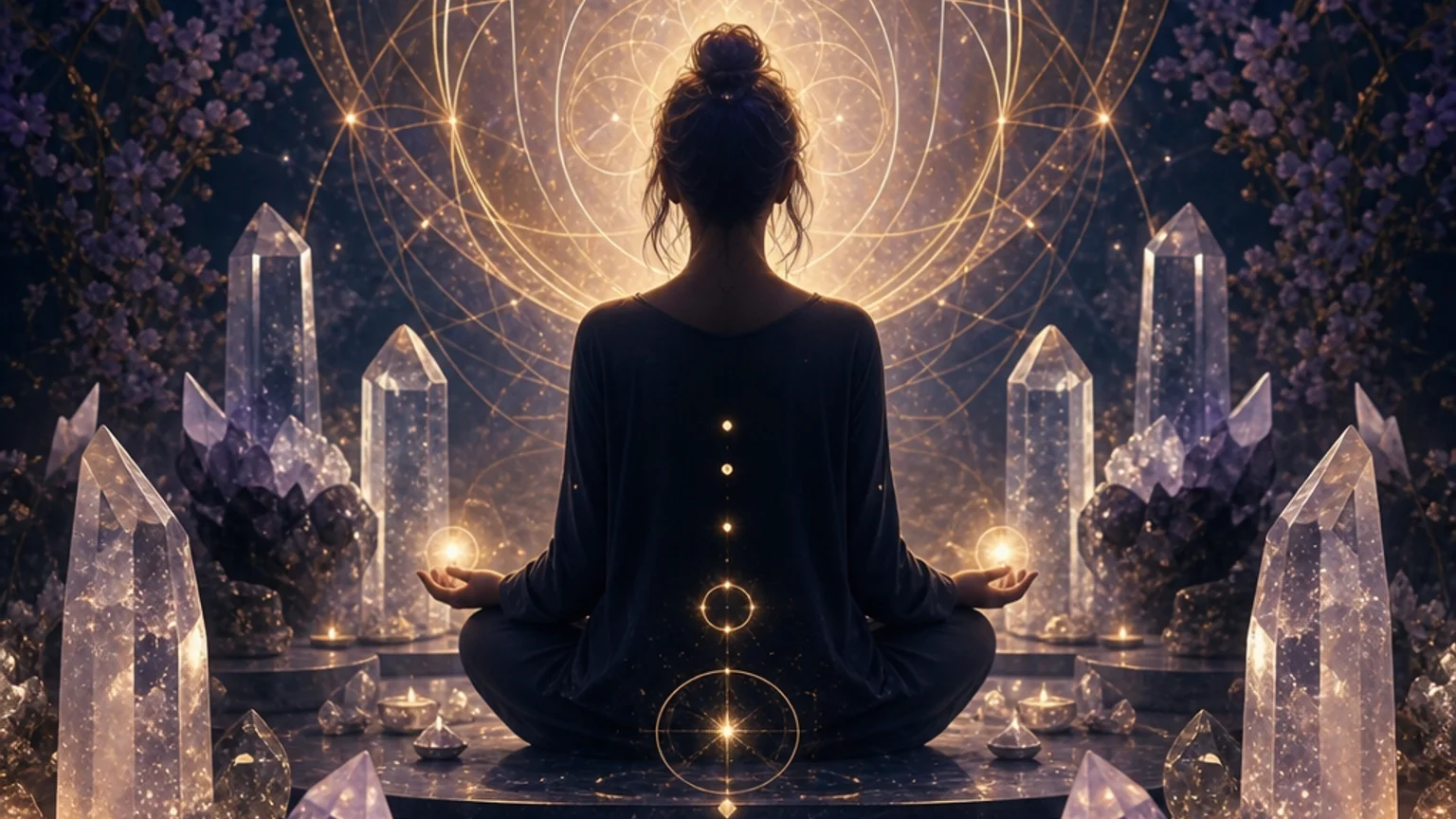
Crystals for Shadow Work Meditation: 7 Stones for Inner Integration
Crystals for Shadow Work Meditation: 7 Stones for Inner Integration
A shadow work meditation uses dark, reflective, or iridescent stones alongside a witnessing, non-judgmental attention to gently look at the parts of yourself that have been hidden, suppressed, or pushed away — not to fix them, but to integrate. This guide covers seven stones traditionally paired with this kind of depth practice.
- Crystals: Black Obsidian, Labradorite, Smoky Quartz
What Is Crystals for Shadow Work Meditation?
A shadow work meditation uses dark, reflective, or iridescent stones alongside a witnessing, non-judgmental attention to gently look at the parts of yourself that have been hidden, suppressed, or pushed away — not to fix them, but to integrate. This guide covers seven stones traditionally paired with this kind of depth practice.
Crystals for Shadow Work Meditation Explained
When we speak of crystals for shadow work meditation, we are referring to a focused practice that pairs reflective or dark-hued stones with steady, non-judgmental attention. This approach does not seek to erase difficult emotions or repress memories. Instead, it invites a gentle witness to observe what has been pushed aside. Over decades of contemplative study and mineralogical research, practitioners have found that specific stones—each with distinct optical properties and crystalline structures—can serve as tactile anchors during these sessions. Earthward presents seven stones traditionally aligned with this depth practice, offering a structured path toward inner integration.
How to Practice
- Step 1: [object Object]
- Step 2: [object Object]
- Step 3: [object Object]
- Step 4: [object Object]
- Step 5: [object Object]
- Step 6: [object Object]
Meaning & Benefits
Shadow work meditation is a contemplative method that uses dark, reflective, or iridescent stones alongside a witnessing, non-judgmental attention to gently examine suppressed or hidden aspects of the self. The goal remains integration rather than correction. While the term originates from Carl Jung’s analytical psychology, many meditators draw parallel frameworks from Eastern contemplative systems. In the Theravada tradition, shamatha (止) and vipassana (观) cultivate steady sati toward defilements (kilesa). In the Tibetan tradition of Dzogchen, practitioners observe the nature of mind without fabrication. Daoist inner alchemy describes the regulation of breath and intent during 子午卯酉 活子时 to maintain internal balance. These traditions do not replace the Jungian model; they simply offer complementary lenses for steady observation. Note that shadow work is a Western psychology concept; this guide maintains a Jungian stance while acknowledging Chöd (施身法 — Machig Labdrön tradition, facing rather than driving away inner projections) and asubha bhāvanā (不净观) as non-equivalent parallels.
Practice Steps:
1. Sit comfortably with your spine aligned. Hold a dark stone against your solar plexus. Inhale for four counts, exhale for six counts, visualizing a slow tide receding over smooth stones.
2. Close your eyes. Place your thumb and index finger together at the center of your chest. Breathe in for five seconds, out for seven seconds, imagining a soft gray mist gathering around your ribs.
3. Rest the stone between your eyebrows. Inhale for four, hold for two, exhale for six. Picture an unlit lantern slowly warming from within, revealing faint outlines of familiar rooms.
4. Lay the stone flat on your lower abdomen. Breathe in for three, out for four. Visualize heavy roots extending from your feet into cool, damp soil, anchoring you as you notice a quiet presence beside you.
5. Hold the stone in your left hand. Inhale for five, exhale for five. Imagine a still mirror reflecting a dim hallway, allowing you to watch passing shapes without reaching out.
6. Place the stone behind your neck. Breathe in for four, out for eight. Picture a thick wool blanket settling over your shoulders, creating a safe perimeter while you observe a single flickering candle flame.
Key Facts
| Aspect | Detail |
|---|---|
| Practice | how-to |
| Reveals | A shadow work meditation uses dark, reflective, or iridescent stones alongside a witnessing, non-judgmental attention to gently look at the parts of yourself that have been hidden, suppressed, or pushed away — not to fix them, but to integrate. |
| Supporting Crystals | Black Obsidian, Labradorite, Smoky Quartz |
Crystals to Deepen Your Practice
The following seven stones were selected for their optical behavior and mineral composition, which align well with sustained contemplative focus. Each entry pairs a brief note on its crystalline structure, its historical or traditional context, and a practical mindfulness application. Many people find that holding these stones provides a consistent sensory reference point, supporting a steady gaze inward without forcing outcomes.
- Black Obsidian —
Black Obsidian forms when felsic lava cools too rapidly for crystals to develop, resulting in a natural volcanic glass with a conchoidal fracture pattern. Its deep black color comes from microscopic iron and magnesium oxides trapped within the amorphous structure. Historically, Mesoamerican observers used polished obsidian sheets as reflective surfaces for quiet self-examination. During meditation, many people hold a smooth piece against their sternum while tracking a slow inhale-exhale cycle. The cool, glassy surface offers a sharp sensory contrast that helps return attention to the present moment without demanding mental effort.
} - Labradorite —
Labradorite belongs to the plagioclase feldspar family and exhibits a distinctive optical phenomenon called labradorescence. This flash of blue, green, or gold arises from microscopic exsolution lamellae—thin alternating layers of sodium-rich and calcium-rich feldspar—that scatter incoming light. In northern European folk practice, rough specimens were sometimes carried as protective talismans, while Sami traditions associated the stone with clarity during long winter nights. When used in seated practice, many meditators rest the stone in their lap and follow a rhythmic breathing pattern of four counts in, six counts out. The sudden color shifts appear only when the stone moves slightly, serving as a reminder to observe emotional fluctuations without grasping or pushing them away.
} - 煙晶 —
煙晶 is a variety of silicon dioxide where natural background radiation interacts with trace aluminum impurities, creating structural color centers that tint the crystal from pale amber to deep brown. Its rigid tetrahedral lattice remains highly stable under pressure, making it a durable companion for prolonged sitting. Celtic practitioners historically polished smoky pieces for grounding rituals, and some Himalayan monastic communities kept similar stones near meditation cushions to maintain posture awareness. During practice, placing the stone on the floor beneath your seat while counting ten slow breaths can reinforce physical stability. The warm, muted tones often help soften the intensity of deep reflection, allowing attention to rest lightly on whatever arises.
} - Amethyst —
Amethyst shares the alpha-quartz crystal structure but gains its violet hue from gamma radiation interacting with iron impurities within the silicate lattice. The same structural arrangement also produces weak piezoelectric responses under mechanical stress, a property well documented in mineral physics. In Buddhist practice, amethyst beads were commonly strung into malas for counting recitations, valued for their steady weight and cool temperature. Many meditators drape a strand around their wrists or hold a single tumbled stone while practicing anapanasati (mindful breathing). The gentle purple tones often support a relaxed jaw and lowered shoulder tension, helping the body settle into a posture that favors sustained awareness.
} - 黑碧璽 —
黑碧璽 is a borosilicate mineral characterized by a complex crystal chemistry that includes iron, magnesium, and lithium. Its elongated prismatic structure generates permanent electrical polarization along the c-axis, giving the stone notable piezoelectric and pyroelectric qualities. Portuguese mariners historically loaded it into ship holds as stabilizing ballast, while traditional healers in Brazil incorporated the stone into protective rituals. In a seated meditation routine, resting the stone against the base of the spine while inhaling for five seconds and exhaling for seven can help establish a sense of physical boundary. The dense, matte finish absorbs ambient light, which many people find useful when transitioning from active thought to quiet observation.
} - Moonstone —
Moonstone belongs to the alkali feldspar group and displays adularescence, a soft billowing glow caused by the intergrowth of two feldspar phases with differing refractive indices. As light passes through these alternating layers, it scatters and creates a moving luminance that shifts with viewing angle. In South Asian cultural contexts, moonstone was frequently carved into ceremonial objects and linked to cyclical timekeeping practices. Meditators often place a smooth cabochon on their tongue or rest it on the collarbone while practicing metta (loving-kindness) phrasing. The stone’s gentle, diffused light can soften rigid self-criticism, inviting a more patient stance toward recurring emotional patterns.
} - Malachite —
Malachite is a copper carbonate hydroxide mineral that forms distinctive concentric banding as environmental conditions shift during its crystallization. The vivid green shades result from hydrated copper ions within the lattice, and the stone’s relatively soft hardness means it cleaves along predictable planes. Ancient Egyptian artisans quarried malachite for pigment and ornamental objects, while later European metalworkers prized it for decorative inlay. When held during practice, many people follow a simple body scan from toes to crown while breathing in for four counts and out for six. The stone’s cool surface and visible growth rings can serve as a tactile map, helping attention track subtle shifts in tension without rushing toward resolution.
}
Explore Best Crystals for Meditation, focus, sleep, grounding guides.
Eastern Traditions
西方:Carl Jung 的 ‘shadow’ (Schatten) 概念源于分析心理学 — 本页 framing 主以此为根。东方平行参照(非等价):藏传 Chöd(施身法 — Machig Labdrön 传统,’feeding the demons’ 即面对而非驱除内心阴暗);南传 asubha bhāvanā(不净观)与 defilements (kilesa) 的 sati。注意:shadow work 是 Western psychology 概念,本页保持 Jungian 立场不强行东方对应。
常見問題
What are the best crystals for shadow work meditation?
How often should I practice shadow work meditation? Most contemplative teachers suggest one to three short sessions per week, allowing time between visits to process observations naturally. Can I use multiple stones at once? Yes, but starting with a single specimen helps maintain focus. Many people rotate stones depending on the emotional texture of their session, treating each crystal as a separate mindful anchor rather than a combined toolkit. Is this method scientifically proven? The mineralogical properties of these stones are well documented, while the psychological benefits stem from established mindfulness frameworks and self-reflection practices. Results vary, and the process remains a personal exploration rather than a standardized treatment.
How is shadow work meditation different from emotional release?
How often should I practice shadow work meditation? Most contemplative teachers suggest one to three short sessions per week, allowing time between visits to process observations naturally. Can I use multiple stones at once? Yes, but starting with a single specimen helps maintain focus. Many people rotate stones depending on the emotional texture of their session, treating each crystal as a separate mindful anchor rather than a combined toolkit. Is this method scientifically proven? The mineralogical properties of these stones are well documented, while the psychological benefits stem from established mindfulness frameworks and self-reflection practices. Results vary, and the process remains a personal exploration rather than a standardized treatment.
Is shadow work meditation safe?
How often should I practice shadow work meditation? Most contemplative teachers suggest one to three short sessions per week, allowing time between visits to process observations naturally. Can I use multiple stones at once? Yes, but starting with a single specimen helps maintain focus. Many people rotate stones depending on the emotional texture of their session, treating each crystal as a separate mindful anchor rather than a combined toolkit. Is this method scientifically proven? The mineralogical properties of these stones are well documented, while the psychological benefits stem from established mindfulness frameworks and self-reflection practices. Results vary, and the process remains a personal exploration rather than a standardized treatment.
What if something painful comes up during shadow work?
How often should I practice shadow work meditation? Most contemplative teachers suggest one to three short sessions per week, allowing time between visits to process observations naturally. Can I use multiple stones at once? Yes, but starting with a single specimen helps maintain focus. Many people rotate stones depending on the emotional texture of their session, treating each crystal as a separate mindful anchor rather than a combined toolkit. Is this method scientifically proven? The mineralogical properties of these stones are well documented, while the psychological benefits stem from established mindfulness frameworks and self-reflection practices. Results vary, and the process remains a personal exploration rather than a standardized treatment.
How long should a shadow work meditation be?
How often should I practice shadow work meditation? Most contemplative teachers suggest one to three short sessions per week, allowing time between visits to process observations naturally. Can I use multiple stones at once? Yes, but starting with a single specimen helps maintain focus. Many people rotate stones depending on the emotional texture of their session, treating each crystal as a separate mindful anchor rather than a combined toolkit. Is this method scientifically proven? The mineralogical properties of these stones are well documented, while the psychological benefits stem from established mindfulness frameworks and self-reflection practices. Results vary, and the process remains a personal exploration rather than a standardized treatment.
Which crystal is best for beginners to shadow work?
How often should I practice shadow work meditation? Most contemplative teachers suggest one to three short sessions per week, allowing time between visits to process observations naturally. Can I use multiple stones at once? Yes, but starting with a single specimen helps maintain focus. Many people rotate stones depending on the emotional texture of their session, treating each crystal as a separate mindful anchor rather than a combined toolkit. Is this method scientifically proven? The mineralogical properties of these stones are well documented, while the psychological benefits stem from established mindfulness frameworks and self-reflection practices. Results vary, and the process remains a personal exploration rather than a standardized treatment.
Should I journal after a shadow work meditation?
How often should I practice shadow work meditation? Most contemplative teachers suggest one to three short sessions per week, allowing time between visits to process observations naturally. Can I use multiple stones at once? Yes, but starting with a single specimen helps maintain focus. Many people rotate stones depending on the emotional texture of their session, treating each crystal as a separate mindful anchor rather than a combined toolkit. Is this method scientifically proven? The mineralogical properties of these stones are well documented, while the psychological benefits stem from established mindfulness frameworks and self-reflection practices. Results vary, and the process remains a personal exploration rather than a standardized treatment.
Is shadow work the same as therapy?
How often should I practice shadow work meditation? Most contemplative teachers suggest one to three short sessions per week, allowing time between visits to process observations naturally. Can I use multiple stones at once? Yes, but starting with a single specimen helps maintain focus. Many people rotate stones depending on the emotional texture of their session, treating each crystal as a separate mindful anchor rather than a combined toolkit. Is this method scientifically proven? The mineralogical properties of these stones are well documented, while the psychological benefits stem from established mindfulness frameworks and self-reflection practices. Results vary, and the process remains a personal exploration rather than a standardized treatment.
Related Meditation Guides
- Crystals for Anxiety Meditation
- Crystals for Morning Meditation
- Crystals for Self-Love Meditation
- Crystals for Confidence Meditation
- Crystals for Creativity Meditation
- Crystals for Gratitude Meditation
- Best Crystals for Meditation
Meditation and crystal practices are tools for wellbeing and self-reflection, not substitutes for medical or mental health treatment.