

Turquoise and Citrine Together: Benefits, Meaning + How to Use
Turquoise and Citrine Together: Benefits, Meaning + How to Use
Quick Answer
Yes — Turquoise and Citrine can be worn together (compatibility score: 80/100 — Harmonious). It’s a sky-and-sun pairing that shows up often in crystal practice: earthy protection on one side, fiery abundance on the other.
About Turquoise
Turquoise is an opaque blue-to-green stone, traditionally associated with protection, communication, and friendship. In crystal practice it’s often linked with the Throat and Third Eye chakras, which makes it a natural fit for honest self-expression and everyday protection. It’s a long-standing December birthstone, and one of the oldest stones humans ever set into jewelry — worn across Persian, Native American, and Egyptian traditions for thousands of years. Common forms include cabochons, beads, pendants, and inlay work.
Mineralogically, Turquoise is a copper aluminum phosphate hydrate (CuAl₆(PO₄)₄(OH)₈·4H₂O) with a Mohs hardness of 5–6. That is softer than most quartz-family stones, and its surface is porous. Keep it away from water, salt water, and prolonged direct sun. So Turquoise is best as a pendant, bead, or inlay piece that avoids daily wetting — not a ring that takes a lot of knocks.
Turquoise Meaning → · Genuine, ethically sourced — not dyed, not glass.
About Citrine
Citrine is a warm yellow to golden-orange variety of quartz, traditionally associated with abundance, confidence, and motivation. In crystal practice it’s often linked with the Solar Plexus and Sacral chakras, which makes it a popular pick for morning energy, self-worth, and the kind of forward drive people like to carry into a workday. Its color comes from iron, and unlike most stones it’s traditionally said to be self-cleansing. Common forms include bracelets, rings, pendants, tumbled stones, raw points, clusters, and geodes.
Mineralogically, Citrine is silicon dioxide (SiO₂) with a Mohs hardness of 7 — durable enough for everyday bracelets, rings, and pendants. It tolerates a brief water rinse, holds its color in sunlight, and is salt-safe. That durability is what sets it apart from softer stones like Turquoise.
Citrine Meaning → · Genuine, ethically sourced — not dyed, not glass.
Can You Wear Turquoise and Citrine Together?
Practically: Turquoise and Citrine can be worn together, but they ask for different care. Citrine is a durable quartz at 7 on the Mohs scale, happy on an everyday bracelet or ring. Turquoise is a softer, porous stone at 5–6 that should stay clear of water, salt, and prolonged sun. That makes Citrine the better everyday wearable, and Turquoise the better pendant, cabochon, or inlay piece. Visually, the cool blue-green of Turquoise against the warm gold of Citrine is a striking complementary contrast — a sky-and-sun palette that reads well in a bracelet or pendant pairing.
Energetically: In crystal tradition the two sit on complementary elements. Turquoise carries an earthy, protective, communicative quality; Citrine brings a fiery, abundant, motivating one. The earth-and-fire combination is traditionally seen as steady ground giving the active fire energy something to build on, rather than scatter. With Turquoise’s throat-and-third-eye focus and Citrine’s solar-plexus center, the pairing is often described as linking honest expression with the confidence to act on it.
Psychologically: The two stones carry complementary intentions — protection and communication on one side, abundance and confidence on the other. That makes the pairing work well as a single ritual anchor: one intention (speaking up, showing up, stepping into something new) carried by two reinforcing stones instead of two competing ones. Many people reach for this combination when they want both steadiness and forward motion at the same time.
These properties are traditionally associated with crystal practice; many people find the pairing supportive, though the effects are not established by modern research.

Benefits of Turquoise + Citrine
Together, Turquoise and Citrine cover six complementary strengths:
1. Grounded Confidence
The earth-and-fire pairing gives confidence a steadier base. Citrine is traditionally associated with self-worth and forward-moving motivation, while Turquoise is chosen for its grounding, protective quality. Worn together, the feeling is often described as confidence that doesn’t tip into restlessness — a calm drive rather than a jittery push. It’s the kind of combination people slip on before a meeting, a conversation, or anything where they want to feel both rooted and capable.
2. Honest, Confident Expression
Turquoise is linked to the Throat chakra and the courage to speak honestly. Citrine is linked to the Solar Plexus and the self-worth behind that voice. Together they cover both halves of communication: the steadiness to say what you mean, and the warmth to say it well. It’s a popular combination for people who present, teach, or negotiate — and for anyone who simply wants to feel more at ease speaking up in front of others.
3. Protection Meets Abundance
Turquoise is one of the older stones used for everyday protection, and Citrine is among the most popular for abundance intentions. Combined, the pairing covers two intentions at once — guarding the wearer while keeping a forward-looking, opportunistic energy. It’s a common setup for a workspace, a desk, or a front entrance, where people want the area to feel both kept and open to opportunity.
4. Earth-and-Fire Balance
The complementary elements give this pairing a balance that’s hard to get from two stones of the same element. In crystal tradition, earth energies are steadying and grounding; fire energies are active and expansive. Together they’re said to support momentum that lasts, rather than a quick burnout. Many people describe the combination as motivating without being overstimulating — which is a big part of why it works as a daytime pair.
5. A Bright, Daily Lift
Citrine is traditionally associated with morning energy and a sunny, optimistic mood, while Turquoise is valued for the calm and protection it brings to a day. Together they make a natural daytime combination — the kind of pairing people slip on in the morning as a small ritual for showing up fully. Unlike heavier evening stones, this pair tends to be chosen for the part of the day that asks for both energy and composure.
6. Complementary Chakra Flow
With Turquoise linked to the Throat and Third Eye and Citrine to the Solar Plexus and Sacral, the pairing touches a wide vertical range of the body’s traditional energy centers — from personal power up through expression and intuition. Many practitioners describe this as a flowing connection that runs from voice to gut to inner sight, useful for journaling, intention-setting, or any practice that bridges inner insight with outward action.
How to Use Turquoise and Citrine Together
Wear them
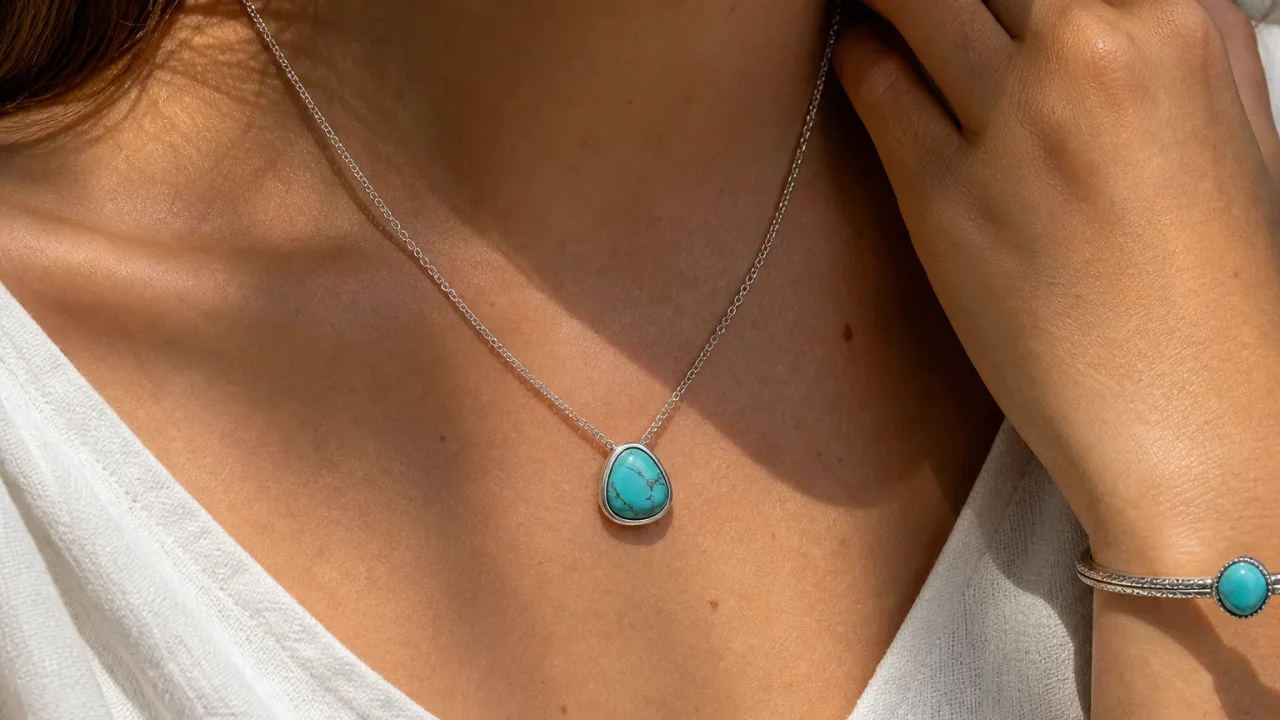
A common question is can I wear Turquoise and Citrine on the same hand? Yes — the complementary earth-and-fire pairing is traditionally considered comfortable together. A Citrine bracelet is the better everyday wearable on the wrist, while Turquoise often works best as a pendant or cabochon that avoids daily water exposure. If you stack them, keep Turquoise beads from rubbing against harder stones, since Turquoise (Mohs 5–6) is softer and can dull over time. For a Turquoise and Citrine bracelet pairing, alternate beads or wear one per wrist to reduce friction.
Meditate
Hold Citrine in one hand and rest Turquoise nearby — on your lap, a mat, or an altar — rather than gripping both at once. Five to ten minutes is enough for a simple ritual, especially if you’re new to working with these two stones. The aim is a clearer sense of grounded motivation — steady and warm at once — not a particular physical sensation. Citrine is often described as the warmer, activating stone; Turquoise as the steadier, protective one.
Crystal grid
Place a Citrine point at the center to anchor abundance and motivation, with Turquoise cabochons or beads around it to set protection and honest communication as the supporting intent. It’s a classic, simple grid for confidence, expression, or new beginnings — easy to set up on a desk, nightstand, or small table when you want a steady, forward-moving feel in a space.
Place in a room
A Citrine cluster on a desk or workspace keeps the area feeling bright and opportunity-focused. A Turquoise pendant or cabochon nearby brings a protective, communicative tone. Together they turn a workspace, entryway, or creative corner into a room that feels both grounded and energized. Many people start here when they want a daytime environment that supports clear communication without losing momentum.
Caring for Turquoise + Citrine
Each stone has its own care needs:
- Turquoise: Water: Avoid water · Sun: Avoid prolonged sun · Salt: Avoid salt water.
- Citrine: Water: Brief rinse safe · Sun: Sun-safe (color stable) · Salt: Salt-safe.
When in doubt, cleanse both with sound or moonlight — methods that are gentle across all stone types.
How to cleanse your crystals →
Shop Turquoise + Citrine
Every stone below is genuine, ethically sourced, and real — not dyed, not glass.
Bundle any 3 and save 20%.
Shop Crystals for This Guide
Explore crystal jewelry and stones from our current collection.




常見問題
Can I wear Turquoise and Citrine together every day?
Many people do. If you’re new to combining stones, start with a few hours and notice how the pairing feels before making it a daily habit.
Can I wear Turquoise and Citrine on the same hand?
You can. Some wearers follow the tradition of keeping calming stones on the receiving (left) hand and active ones on the giving (right) hand, but it comes down to personal preference.
Can I sleep with Turquoise and Citrine?
You can keep them nearby while you sleep. Turquoise is often placed on the wrist or nightstand, while Citrine can rest on the nightstand or nearby.
How do I cleanse Turquoise and Citrine?
Turquoise: Water: Avoid water · Sun: Avoid prolonged sun · Salt: Avoid salt water. Citrine: Water: Brief rinse safe · Sun: Sun-safe (color stable) · Salt: Salt-safe. When in doubt, sound or moonlight cleansing is gentle across all stone types.
Can I add a third stone to Turquoise and Citrine?
Yes — Clear Quartz is a neutral amplifier that bridges most pairings without competing. Add one stone at a time so you can notice each shift.
Related
- Turquoise Meaning
- Citrine Meaning
- How to Cleanse Crystals
- Tiger Eye and Citrine
- Carnelian and Citrine
- Citrine and Malachite
- Citrine and Apatite
- Crystal Compatibility Checker
Crystal meanings are shared for entertainment and spiritual practice. They’re not a substitute for professional medical or mental-health care.