
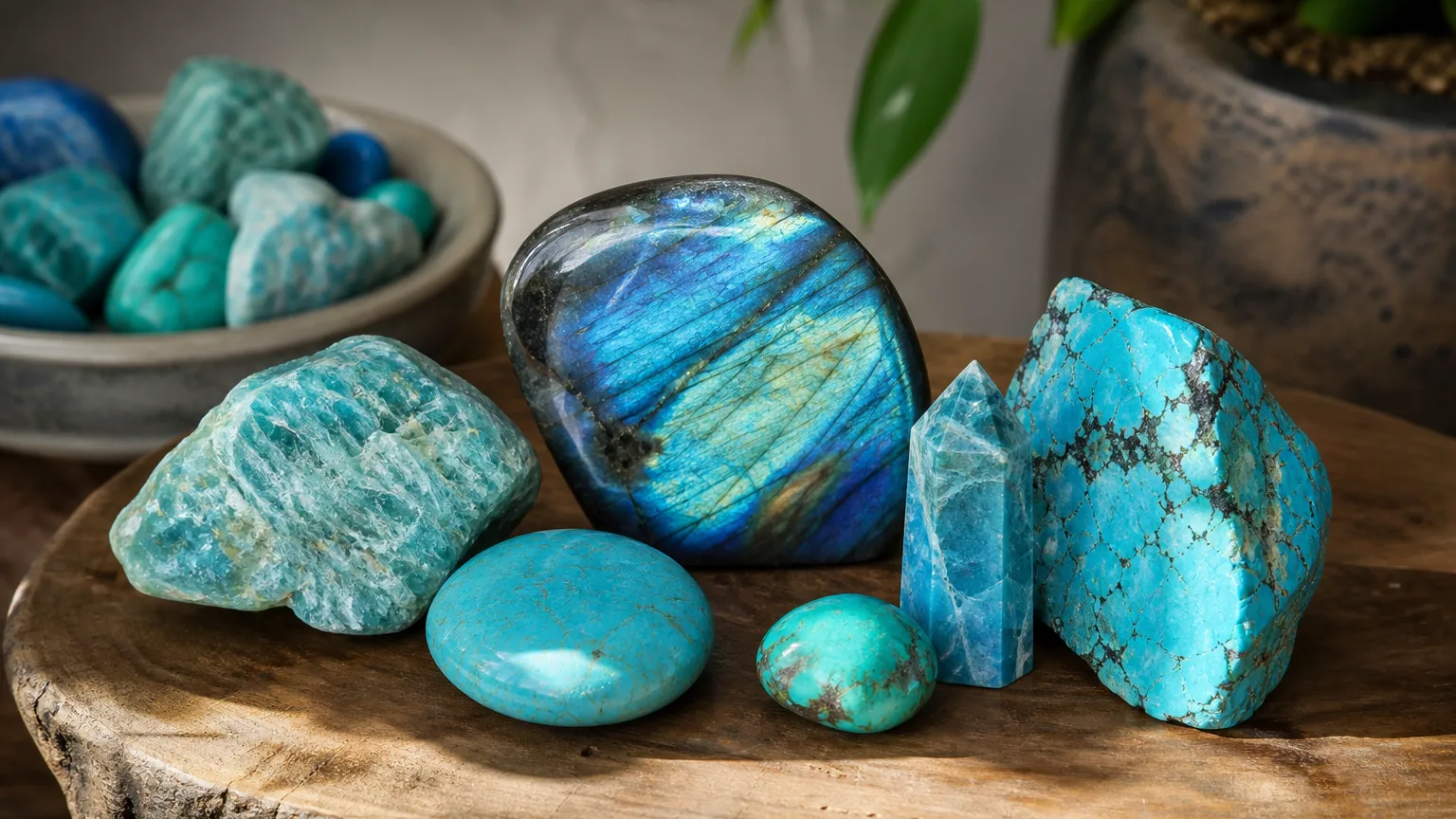
Best Throat Chakra Crystals: Stones for Balance, Energy & Mindful Rituals
Quick Answer: Best Crystals for the Throat Chakra
The best crystals for the Throat Chakra include Labradorite, Amazonite, Turquoise, traditionally used in mindfulness and spiritual practices. Crystal properties are complementary wellness tools, not medical treatments.
Understanding the Throat Chakra
The Throat Chakra, or Vishuddha in Sanskrit, sits at the center of the neck and is the bridge between what you think and what you say. In traditional chakra theory, it is the energy center responsible for expression, listening, and living in line with what you genuinely believe. When it flows well, words arrive clearly, boundaries feel possible, and you can disagree without shrinking. When it feels blocked, the signals show up as a catch in the voice, a habit of swallowing opinions, or talking over others to fill the quiet.
Across cultures, the throat has long been treated as a seat of power. Tibetan and Indian chant traditions work directly with vibration in this area, and many indigenous practices use song, drum, and spoken prayer as medicine. The thread is consistent: the voice is something you tend, not something you switch on. Working with blue stones is simply one way to bring gentle attention back to this part of the body, much like a focal point in meditation.
In modern terms, the Throat Chakra maps onto everyday situations most people recognize, the meeting where you stayed quiet, the difficult text you rewrote five times, the honest sentence that finally felt like relief. Tending it is less about reaching some ideal of boldness, and more about closing the gap between your inner voice and the words that actually leave your mouth. Crystals, breathing, and mindful speech are tools that many people use together to slowly rebuild that alignment.
Quick facts: Sanskrit Vishuddha · Position: Throat · Color: Blue · Element: Ether/Air. Balanced: Clear expression, authentic voice. Out of balance: Fear of speaking, dishonesty, being unheard.
Not sure which chakra to focus on? Take the free Chakra Test ↗
12 Best Crystals for the Throat Chakra
Labradorite
Chakra: Throat, Third Eye
Color: Grey-black body with blue/gold/green flash
Element: Water
Best for: Change, Intuition, Creativity
Best way to use: Wear as jewelry
Zodiac: Leo, Sagittarius
Affirmation: I trust the voice that arrives when I stop performing.
Labradorite is a feldspar prized for labradorescence, the flashes of blue, gold, and green that appear as light moves across its surface. Mineralogically, this play of color comes from microscopic layered structures inside the stone, giving it a quiet, shifting glow that rewards attention. Held in the hand it feels cool and slightly oily, with a weight that invites slow turning during conversation or reflection. Traditionally associated with the Throat and Third Eye chakras, many people keep labradorite close when navigating change or preparing to speak about something personal, using it as a grounding anchor that supports honest, measured expression. As a mindfulness companion, the simple act of watching its colors shift can settle a racing mind before a difficult talk.
Read full Labradorite meaning →
Amazonite
Chakra: Heart, Throat
Color: Blue-green, turquoise-green
Element: Water
Best for: Communication, Calm, Honesty
Best way to use: Wear as jewelry
Zodiac: Virgo, Aquarius
Affirmation: I say what is true for me, gently and clearly.
Amazonite is a microcline feldspar whose blue-green to turquoise-green color comes from trace lead and water in its crystal structure. The stone has a soft, slightly dusty hue that reads as calm and approachable, the visual equivalent of a steadier voice. Polished pieces feel smooth and cool, pleasant to thumb during a tense exchange. Often used for the Heart and Throat chakras, amazonite is traditionally associated with honest, compassionate communication, especially when old arguments or unspoken feelings are involved. Many people hold it before a hard conversation as a mindful pause, a small ritual of intention that helps them listen as carefully as they speak.
Turquoise
Chakra: Throat, Third Eye
Color: Blue to green
Element: Earth
Best for: Communication, Protection, December birthstone
Best way to use: Wear as jewelry
Zodiac: Sagittarius, Pisces, Aquarius
Affirmation: My words carry the weight of what I value.
Turquoise is a hydrous copper aluminum phosphate whose color ranges from sky blue to green, deepening as copper dominates and shifting toward green when iron enters the mix. As the traditional December birthstone, it has been worn across cultures for thousands of years, from Persian amulets to Native American ceremonial pieces. The stone feels waxy and warm in the hand, with a color psychology linked to openness and ease. Traditionally associated with the Throat chakra and with protection for travelers and speakers, many people wear turquoise when they want to feel steady and well-spoken. As a self-care object, pausing to touch a worn ring can become a small daily reminder to breathe before answering.
Lapis Lazuli
Chakra: Third Eye, Throat
Color: Deep blue with gold and white
Element: Air
Best for: Meditation, Communication, Focus
Best way to use: Wear as jewelry
Zodiac: Sagittarius, Libra
Affirmation: I give honest words the room they deserve.
Lapis Lazuli is technically a rock rather than a single mineral, a mix of lazurite, calcite, and pyrite that produces its signature deep blue scattered with gold flecks. The pyrite sparkles like a night sky, a visual that has linked it to royalty and sacred speech from ancient Egypt to the Renaissance. The polished surface feels dense and cool, with a satisfying weight in a pendant. Traditionally associated with the Third Eye and Throat chakras, lapis is often used by people preparing to articulate a truth they have been circling for a while. As a focus object in meditation, its rich color gives the eye somewhere soft to rest while the mind settles enough to speak.
Read full Lapis Lazuli meaning →
Fluorite
Chakra: Third Eye, Throat, Heart (color-linked)
Color: Purple, green, blue, yellow, rainbow
Element: Air
Best for: Study, Concentration, Work
Best way to use: Carry or hold in meditation
Zodiac: Pisces, Capricorn
Affirmation: I sort my thoughts before I let them out.
Fluorite is a calcium fluoride mineral, formula CaF₂, famous for banding in purple, green, blue, and yellow, sometimes all in one piece. Blue and green fluorite are the varieties most often placed at the Throat chakra, where the cool translucent tones read as clarity and order. The stone is relatively soft, so it is usually held or carried rather than worn rough. Many people reach for fluorite when their thinking feels tangled before a presentation or written reply, using it as a tactile anchor that supports focus and clear sequencing of ideas. As a study companion, turning a banded piece while reading can keep the hands busy and the voice rehearsed.
Kyanite
Chakra: Throat, Third Eye
Color: Blue (also black, green, orange)
Element: Air
Best for: Communication, Meditation, Focus
Best way to use: Wear as jewelry
Zodiac: Aries, Libra
Affirmation: I let my words flow without forcing them.
Kyanite is an aluminum silicate mineral that forms in long bladed crystals, most commonly in a clean, slightly steely blue. Its name comes from the Greek for blue, and its fibrous, blade-like habit gives each piece a directional, almost flowing texture. Blue kyanite is the form placed at the Throat chakra, where its even color and calm presence are traditionally associated with clear, unforced speech. Many people lay a blade horizontally across the lower neck during meditation as a focal point for the breath. As a self-care cue, the smooth flat edge can be pressed lightly against the skin during slow exhales to mark a pause before speaking.
Larimar
Chakra: Throat, Heart
Color: Blue, White
Element: Water
Best for: Calm, Emotional balance, Communication
Best way to use: Wear as jewelry
Zodiac: Leo, Pisces
Affirmation: I soften my voice and let myself be heard.
Larimar is a rare blue variety of pectolite found only in the Dominican Republic, colored by copper substituting for calcium in its structure. Its patterns of white and blue resemble sunlight on shallow seawater, a look that reads as gentle and reassuring. The polished stone feels cool and smooth against the skin, ideal for a pendant resting near the throat. Traditionally associated with the Throat and Heart chakras, larimar is often used by people who tend to speak too sharply or too fast, as a reminder to slow down and breathe between sentences. As a mindfulness token, holding it during a tense moment can mark a return to a calmer pace.
Apatite
Chakra: Throat, Third Eye
Color: Blue-green, blue, green, yellow, violet
Element: Fire
Best for: Motivation, Creative work, Expression
Best way to use: Wear as jewelry
Zodiac: Gemini, Libra
Affirmation: I give shape to the ideas I have been holding back.
Apatite is a phosphate mineral that appears in blue, blue-green, green, and yellow, with the blue-green forms most often placed at the Throat chakra. Its color is bright and slightly electric, a tone linked in color psychology to stimulation and creative momentum. Polished apatite feels glassy and light, easy to carry in a pocket during a workday. Traditionally associated with motivation and expression, many people keep apatite on a desk when starting a project that depends on finding the right words, using it as a tangible reminder to begin. As a creative companion, picking it up can serve as a small ritual for shifting from planning into actually speaking or writing.
Angelite
Chakra: Throat, Third Eye
Color: Soft blue
Element: Air
Best for: Gentle expression, Meditation, Calm
Best way to use: Wear as jewelry
Zodiac: Aquarius, Pisces
Affirmation: I speak with care, and I let quiet do its work.
Angelite is a soft blue form of anhydrite, a calcium sulfate mineral; its pale, slightly chalky blue comes from its fine-grained structure. The stone feels light and matte, almost powdery to the touch, and should be kept dry because water can alter its surface. Traditionally associated with the Throat and Third Eye chakras, angelite is often used by people who want to bring more gentleness and patience into how they speak, especially in emotionally charged settings. Many people place a small piece on the chest or beside the neck during meditation as a focal point for slower breathing. As a self-care object, its muted color reads as quiet, a visual reminder that softness is its own kind of strength.
abalone-shell
Chakra: Throat, Heart, Third Eye
Color: Iridescent blue, green, violet
Element: Water
Best for: Calming, Emotional balance, Ocean connection
Best way to use: Wear as jewelry
Zodiac: Aquarius, Pisces, Cancer
Affirmation: I let my feelings move through me and find their words.
Abalone shell is the iridescent inner lining of a marine mollusk, where layers of aragonite, a form of calcium carbonate, catch the light in shifting blues, greens, and violets. This natural iridescence gives each piece a watery, ocean-like depth, a color palette long linked to calm and emotional flow. The shell feels smooth and slightly curved, comfortable to hold during reflection. Traditionally associated with the Throat, Heart, and Third Eye chakras, many people use abalone when working through emotions that have been hard to name or say aloud. As a mindful object, watching the colors shift across its surface can help slow the breath before speaking about something tender.
Read full abalone-shell meaning →
afghanite
Chakra: Throat, Third Eye
Color: Deep vivid blue
Element: Water
Best for: Honesty, Inner knowing, Speaking truth
Best way to use: Wear as jewelry
Zodiac: Sagittarius, Aquarius
Affirmation: I trust the truth that I already know inside.
Afghanite is a rare sodium calcium aluminum sulfate mineral, first identified in Afghanistan, prized for its deep, vivid blue color. The intensity of its blue comes from its specific chemical makeup, and it often occurs alongside lazurite, which places it in the same mineral family as lapis. The stone has a glassy, cool surface with a color that reads as focus and conviction. Traditionally associated with the Throat and Third Eye chakras, afghanite is often used by people working to align their inner knowing with what they actually say, especially when old habits of self-censorship are present. As a meditation focus, holding it can serve as a small commitment to honesty in the conversation ahead.
ajoite
Chakra: Heart, Throat
Color: Blue-green, pale blue-green
Element: Water
Best for: Peace, Gentle Expression, Heart
Best way to use: Wear as jewelry
Zodiac: Cancer, Pisces
Affirmation: I let my heart and my voice speak as one.
Ajoite is a rare hydrated copper silicate that grows as soft blue-green coatings on quartz, often from mines in South Africa. Its color, brought on by copper, ranges from pale blue-green to a gentle turquoise, and it usually appears as a delicate blush over clear quartz rather than as a solid stone. The combined material feels like quartz, cool and glassy, with a quiet color overlay. Traditionally associated with the Heart and Throat chakras, ajoite is often used by people who want their words to carry more warmth and less edge. As a mindful companion, holding a small piece can mark an intention to speak kindly, both to others and to oneself.
How to Choose by Your Throat Chakra Need
Different situations call for slightly different support. Use this table to match what you are working on with the throat stones that are traditionally chosen for it.
| Need | Best Crystals | ¿Por qué? |
|---|---|---|
| I want to speak honestly without being harsh | Amazonite, Ajoite, Larimar | Soft blue-green stones are traditionally linked to blending truth with warmth, easing the edge from difficult words. |
| I freeze up or lose my words in front of others | Lapis Lazuli, Afghanite, Turquoise | Deep blue stones have long been associated with steady presence and the courage to speak at length. |
| I overthink and my message comes out tangled | Fluorite, Kyanite, Apatite | Clearer, sharper-toned stones are often chosen for focus, sequencing thoughts, and getting to the point. |
| I want to speak more gently and slow down | Angelite, Larimar, Abalone Shell | Pale and watery stones are associated with calm pacing, patience, and softer delivery. |
| I am preparing for change or a new chapter | Labradorite, Apatite | Stones with shifting flash or bright tone are traditionally used during transitions and creative starts. |
How to Use Throat Chakra Crystals
These stones are most useful when paired with a simple, repeatable action. A few practical approaches work well for the throat area.
Wear them close to the neck
The most common choice is a pendant or short necklace that rests at the base of the throat, where the Vishuddha center sits. Labradorite, turquoise, lapis, and larimar all suit this placement because they polish well and tolerate everyday wear. A necklace you actually put on each morning is more useful than a perfect piece left in a drawer.
Place them during meditation
Lying down, rest a small tumbled stone, kyanite blade, or angelite piece directly over the hollow of the throat. Stay for five to ten minutes of slow breathing, letting the weight mark where your attention goes. This is also a gentle way to close a journaling session.
Carry one for hard conversations
Slip a piece of amazonite, fluorite, or apatite into a pocket before a meeting, a phone call, or a difficult message. Reaching for it becomes a private pause, a moment to choose your next sentence rather than react.
Where to place them
The Throat Chakra sits at the center of the neck, so jewelry resting at the collarbone, a stone held against the lower neck during meditation, or a piece placed on the desk in front of you while you speak are all natural placements. You do not need direct skin contact for the stone to serve as a focus point; sometimes simply having it in view is enough.
Not sure which chakra to focus on? Take the free Chakra Test ↗
Beyond Crystals: Other Ways to Balance the Throat Chakra
Stones are one tool among several. The throat responds especially well to sound, movement, and small daily rituals that engage it directly.
- Humming and chanting. A few minutes of humming, with the lips closed and the attention on the vibration in your neck, is the simplest way to wake this area up. Chanting a single steady tone, like the traditional ham seed sound, gives the voice somewhere safe to land before you speak to anyone else.
- Journaling before speaking. When a conversation feels loaded, write the honest version first, the one no one else will see. Moving the unfiltered words onto paper often leaves a calmer, clearer sentence to actually say.
- Gentle neck stretches. Slow rolls, looking over each shoulder, and softly dropping the chin toward the chest release physical tension that builds when you hold back words all day. Thirty seconds is enough.
- Blue foods and herbal tea. A mindful cup of chamomile, blue pea flower, or licorice root tea makes a natural pause, while blueberries and dark berries are a simple way to bring the chakra’s color into your day. The ritual of making the tea matters as much as the tea itself.
- Breath before words. One slow exhale before answering a difficult question costs nothing and changes the tone of what follows. Pair it with touching a worn stone and it becomes a reliable habit.
FAQ
Where should I place a throat chakra crystal?
The Throat Chakra sits at the center of the neck, so the most natural placements are a pendant resting at the collarbone, a small stone held over the lower neck during meditation, or a piece kept in view on your desk while speaking or writing. Direct skin contact is traditional but not required; the stone works mainly as a focus point for your attention.
How do I cleanse throat chakra crystals?
Rinse harder stones like quartz-based lapis or labradorite under cool running water and dry them gently. Keep softer or water-sensitive stones, especially angelite, selenite, and kyanite, dry; use sound, moonlight, or a brief pass through incense smoke instead. When in doubt, dry methods are the safer choice, since water can dull or damage softer minerals.
What is the best crystal for the Throat Chakra?
There is no single best stone, since the right choice depends on what you are working on. Many people start with turquoise, amazonite, or lapis lazuli because they are widely available, polish well into jewelry, and have a long history of association with honest speech. Choose by the need rather than by rarity.
Can crystals really unblock my Throat Chakra?
From a scientific standpoint, there is no clinical proof that crystals unblock a chakra or change the voice. What studies do suggest is that the ritual of holding a meaningful object can reduce stress and improve focus, which often makes calmer, clearer speech easier. Think of these stones as complementary wellness tools, not medical treatments.
Why are most throat chakra crystals blue?
In traditional chakra theory each center is linked to a color, and the Throat Chakra is associated with blue, so blue stones have been chosen for it for centuries. Mineralogically, blue is also a relatively common color in stones that form with copper, such as turquoise, larimar, and azurite-related minerals, which is why so many throat stones happen to share it.
Can I wear more than one at a time?
Yes. Many people combine a pendant, such as larimar, with a pocket stone, such as amazonite, without issue. If you prefer simplicity, a single piece you actually wear daily will serve you better than several kept in a drawer.
Are throat chakra crystals scientifically proven to work?
No. Crystal healing is considered a complementary or spiritual practice rather than an evidence-based therapy, and claims that stones heal illness or fix communication problems are not supported by clinical research. The benefits most people report, feeling calmer, more focused, or more deliberate in speech, are better understood as effects of mindful ritual, attention, and intention rather than the stone itself.