
Best Crystals for Fire Energy: Meaning, Uses & Zodiac Signs
Quick Answer: Best Crystals for the Fire Element
The best crystals for the Fire Element include Tiger Eye, Carnelian, Obsidian, traditionally used in mindfulness and spiritual practices. Crystal properties are complementary wellness tools, not medical treatments.
Understanding the Fire Element
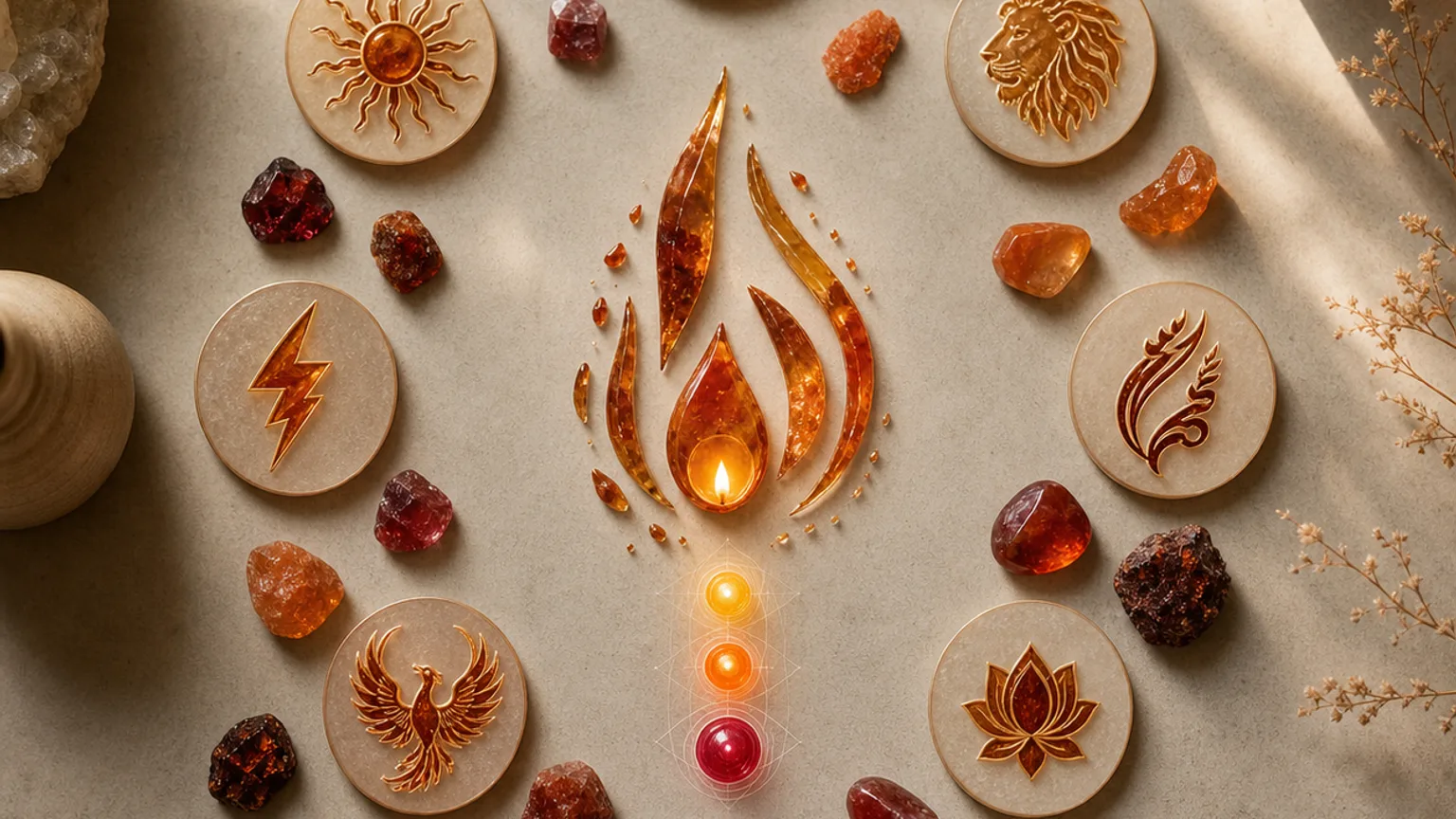
Fire is the element of warmth, motion and transformation. In the classical four-element framework shared across ancient Greek, Indian and medieval European thought, fire sits opposite water and stands for the qualities that move us forward — initiative, courage, creative spark and the willingness to act on what we care about.
At a human level, a balanced fire shows up as motivation and quiet confidence: you wake with a sense of direction, speak up when it matters, and recover quickly when plans change. When fire runs low, the signs tend toward flatness — procrastination, low drive, feeling disconnected from what used to excite you. When it runs too hot, the same energy tips into irritation, rushing, or burnout from pushing without rest.
Culturally, fire has long been linked with the sun and the forge. Ancient Egyptians set carnelian in amulets and called it the “setting sun stone”; Roman soldiers engraved symbols on tiger eye and bloodstone before battle; the Chinese 五行 (Five Elements) system placed fire (火) alongside summer, the south and the color red. These traditions don’t make a stone “powerful” in a measurable sense, but they explain why certain crystals keep showing up in fire-focused practices.
Modern crystal work borrows from this history without copying its claims. A warm-toned stone on a desk or in a pocket can work as a tactile anchor — something physical to touch when you need a small reminder of intent. The meaning comes partly from the stone’s color and weight, and partly from what you choose to associate with it.
Quick facts: Traits: Passion, courage, creativity, transformation. Balanced: Motivated, confident, inspiring. Out of balance: Burnout, anger, impulsiveness. Western zodiac: Aries, Leo, Sagittarius. Feng Shui: South, fame/recognition area.
Not sure if your Fire is balanced? Take the Element Test ↗
12 Best Crystals for the Fire Element
Tiger Eye
Element: Fire
Elemental link: Golden chatoyant bands that catch light like an ember, historically carried for courage and steady willpower
Element action: Builds steady fire for confidence and follow-through
Color: Golden brown (also blue/red)
Chakra: Solar Plexus, Root, Sacral
Zodiac: Leo, Capricorn
Best for: Confidence, Willpower, Grounding
Best way to use: Carry or hold in meditation
Affirmation: I act on what matters with steady, clear resolve
Tiger eye is a quartz variety (SiO₂) whose silky gold-and-brown bands come from parallel fibers of crocidolite that oxidized into limonite — a slow geological process that literally turns blue asbestos into golden silk. Roll a bead in the light and a single bright line slides across the surface, an effect mineralogists call chatoyancy. That moving gleam is part of why tiger eye has been carried as a talisman of courage since Roman times, often engraved before travel or difficult tasks. In fire-element practice it’s the stone you reach for when drive needs to become steady rather than erratic — the courage to keep going on day ten, not just day one. Held in meditation, its smooth weight gives the hands something to focus on while you set a clear intention for the week.
Carnelian
Element: Fire
Elemental link: Warm red-orange color, solar symbolism, traditional courage associations dating to ancient Egypt
Element action: Amplifies fire for motivation and creative start
Color: Orange, red-orange, reddish-brown
Chakra: Sacral, Solar Plexus, Root
Zodiac: Aries, Taurus, Virgo
Best for: Confidence, Starting projects, Creative work
Best way to use: Wear as jewelry
Affirmation: I begin, and I follow through with warmth
Carnelian is a chalcedony quartz whose burnt-orange tone comes from iron oxide scattered through microcrystalline SiO₂. Ancient Egyptians called it the “setting sun stone” and set it in signets, believing warm color would carry warm intent into whatever was sealed. The stone is glassy and cool at first touch but warms quickly against skin, a tactile shift that pairs well with morning routines — many people slip on a carnelian bracelet while setting the day’s first goal. In fire-element work carnelian is the classic stone for low drive and stalled projects: a gentle, steady heat rather than a flare. Held or worn near the lower belly, it’s often used as a reminder to begin the thing you’ve been putting off.
Obsidian
Element: Earth, Fire
Elemental link: Volcanic glass born from quickly cooled lava — fire frozen into a usable form
Element action: Grounds excess fire and shields against scattered heat
Color: Black (also snowflake, rainbow, mahogany)
Chakra: Root, Third Eye
Zodiac: Scorpio, Sagittarius
Best for: Shadow work, Protection, Grounding
Best way to use: Wear as jewelry
Affirmation: I face what I’d rather avoid, and stay steady
Obsidian isn’t a true crystal at all — it’s volcanic glass, lava that cooled so fast minerals couldn’t form an ordered lattice. That fiery origin is exactly why it earns a place on the fire-element list, even though most practitioners also count it as earth. The surface is dark, glassy and mirror-flat, which is why Mesoamerican cultures polished it into scrying mirrors used in reflection and self-inquiry. As a tactile object it’s denser and colder than you expect, then slowly warms in the hand. Fire here is the controlled kind: the heat that protects a boundary instead of leaking it away. Many people keep a small piece at a workspace when tempers or overthinking run high.
Ruby
Element: Fire
Elemental link: Deep “pigeon blood” red from chromium, long tied to bravery and leadership
Element action: Amplifies fire for vitality and brave presence
Color: Deep red (“pigeon blood” is the classic)
Chakra: Root, Heart
Zodiac: Cancer, Leo
Best for: Bravery, Vitality, Leadership
Best way to use: Wear as jewelry
Affirmation: I meet what comes with a brave, open heart
Ruby is the red variety of corundum (Al₂O₃); a few chromium atoms replacing aluminum are enough to turn an otherwise colorless mineral into the most famous red gem on earth. Under sunlight the stone can show a faint internal glow, a fluorescence that made medieval Europeans call rubies “burning coals” set into metal. That image stuck, and for centuries the stone was carried by warriors and rulers as a mark of brave presence. As a fire-element stone ruby is the high-conviction one — reached for when you need to show up fully rather than spark new ideas. Worn at the chest or wrist, its weight is a small physical reminder to stay present and engaged.
Citrine
Element: Fire
Elemental link: Sun-warm yellow to golden-orange tones, traditional “merchant’s stone” of abundance
Element action: Amplifies fire for confidence and morning energy
Color: Yellow, golden-orange, brownish-yellow
Chakra: Solar Plexus, Sacral
Zodiac: Aries, Leo
Best for: Wealth, Confidence, Morning energy
Best way to use: Wear as jewelry
Affirmation: I welcome clear, sun-bright energy into my day
Citrine is the yellow variety of quartz (SiO₂); its color comes from trace iron heated within the earth (or, for much commercial citrine, amethyst or smoky quartz carefully baked to bring out golden tones). The result is a stone that looks like trapped sunlight, which is why 19th-century shopkeepers earned it the nickname “merchant’s stone” — kept near the till to invite clear, confident trade. As a tactile object it’s glassy, light and warm against skin. In fire-element work citrine sits on the constructive side of fire: not the blaze, but the steady warmth that grows something. Many people place a piece on a morning desk or wear it as a small daily anchor for motivation.
Bloodstone
Element: Earth, Fire
Elemental link: Dark green with red iron-oxide spots, carried by soldiers for courage since antiquity
Element action: Grounds fire into stamina and steady courage
Color: Dark green with red spots
Chakra: Root, Sacral, Heart
Zodiac: Aries, Pisces
Best for: Courage, Vitality, Grounding
Best way to use: Wear as jewelry
Affirmation: I stand firm and steady, whatever the day asks
Bloodstone (heliotrope) is a dark green chalcedony flecked with red iron-oxide spots that look like drops caught mid-spread — the source of its old name and most of its lore. Roman soldiers carried engraved bloodstone into battle, and medieval texts claimed it could slow bleeding, which gave the stone its long association with courage under pressure. Held in the hand it’s smooth, dense and cool, then warms slowly. As a fire-element stone it earns its place by keeping courage grounded: the kind of stamina that holds steady through a long week rather than flaring up and burning out. Many people wear it when endurance matters more than excitement.
Read full Bloodstone meaning →
Malachite
Element: Fire
Elemental link: Vivid banded green from copper, long used for transformation and protective growth
Element action: Channels fire into growth and emotional release
Color: Green (banded)
Chakra: Heart, Solar Plexus
Zodiac: Scorpio, Capricorn
Best for: Personal growth, Emotional release, Transitions
Best way to use: Wear as jewelry
Affirmation: I allow steady change, and grow at my own pace
Malachite is a copper carbonate (Cu₂(CO₃)(OH)₂) whose rings of bright and dark green read like a cross-section of growth — which is why it’s been linked, across cultures, to transformation and protective change. Russians clad entire columns of St. Isaac’s Cathedral in malachite, valuing its color the way other cultures valued gold. As a tactile stone it’s softer and more porous than quartz, with a slight waxy feel, and it should sit in jewelry rather than water (more on safe use below). In fire-element work malachite is the transformative one: it’s reached for during transitions, when the heat is doing the work of changing shape rather than pushing outward. Worn near the chest, it’s a reminder that growth can be steady.
Apatite
Element: Fire
Elemental link: Bright blue-green to yellow tones often associated with motivation and clear expression
Element action: Channels fire into motivation and creative voice
Color: Blue-green, blue, green, yellow, violet
Chakra: Throat, Third Eye
Zodiac: Gemini, Libra
Best for: Motivation, Creative work, Expression
Best way to use: Wear as jewelry
Affirmation: I speak what I want, and follow it with action
Apatite is a phosphate mineral (and the source of “appetite” in its name — the stone of wanting, of clarified desire) that ranges from sea-blue to yellow-green depending on trace elements and heating. Unlike the earth-toned stones around it, apatite is bright and translucent, almost glowing against skin, and slightly lighter in the hand than it looks. In fire-element practice apatite bridges motivation and expression: the fire that lights an idea and the voice that says it out loud. Many people working on a stalled creative project hold apatite while naming the next small step, using the stone as a tactile cue to turn a vague wish into a specific plan.
Pyrite
Element: Fire
Elemental link: Brass-yellow metallic gleam that famously strikes sparks, the original “fool’s gold”
Element action: Amplifies fire for motivation, focus and wealth mindset
Color: Brass-yellow, metallic
Chakra: Solar Plexus
Zodiac: Leo
Best for: Motivation, Wealth mindset, Focus
Best way to use: Carry or hold in meditation
Affirmation: I focus, and I build what I set out to build
Pyrite (FeS₂, iron disulfide) is the only stone on this list that literally makes fire — strike two pieces against steel and they produce the sparks that named flint-and-steel ignition. Its cubic brass-yellow crystals earned the nickname “fool’s gold,” and they gleam with a cool metallic brightness that no other crystal here matches. In the hand a piece feels heavy for its size, dense and grounding despite the bright surface. As a fire-element stone pyrite is the focused one: many people keep a cluster on a work desk as a visual anchor for motivation and a steady wealth mindset. Held briefly before starting deep work, it’s a cue to drop distractions and begin.
Adamite
Element: Fire
Elemental link: Bright yellow-green crystals that catch light, traditionally associated with mood lift and joy
Element action: Amplifies fire for warmth, mood and creative spark
Color: Yellow-green, yellow, white, pink
Chakra: Solar Plexus, Heart
Zodiac: Leo
Best for: Mood lift, Creative work, Display
Best way to use: Place in your space
Affirmation: I let warmth and curiosity move through my day
Adamite is a zinc arsenate mineral (Zn₂(AsO₄)(OH)) that forms bright, almost glowing crystal clusters in yellow, yellow-green and occasional pink — colors that read as the cheerful end of fire rather than its fierce end. The crystals are small, sharp and translucent, and they catch daylight in a way that makes a specimen feel lit from within. As a fire-element stone adamite is the one for gentle mood lift rather than drive: a piece placed where you’ll see it during the day can work as a small visual cue toward warmth and creative play. Because arsenate minerals should never sit in water or be handled loosely, it’s best kept as a display stone rather than worn or carried.
Aegirine
Element: Earth, Fire
Elemental link: Dark, blade-like crystals often associated with protection and clearing stagnation
Element action: Grounds and clears excess fire, restores protective boundaries
Color: Dark green to black
Chakra: Root, Sacral, Solar Plexus
Zodiac: Aries, Scorpio, Capricorn
Best for: Protection, Boundaries, Breakthrough
Best way to use: Carry or hold in meditation
Affirmation: I hold my ground, and I move through what is stuck
Aegirine is a sodium iron silicate (NaFeSi₂O₆) that forms long, glossy dark blades — a crystal that looks more like a tool than an ornament. That blade-like habit is part of why it’s traditionally associated with cutting through stagnation and reinforcing boundaries. In the hand a piece feels grounded and a little sharp-edged, cool to the touch and slow to warm. On the fire-element list aegirine plays the protective role: when fire runs too hot and scattered, it helps clear the noise and re-establish a firm edge. Many people hold a small piece while setting a clear boundary they’ve been avoiding — the tactile weight gives the words somewhere to land.
Amber
Element: Fire
Elemental link: Warm honey-to-orange fossil resin that holds sunlight, the original “electron” stone of static charge
Element action: Amplifies fire for warmth, comfort and gentle protection
Color: Yellow, Orange, Brown, Honey
Chakra: Sacral, Solar Plexus
Zodiac: Leo, Aquarius
Best for: Warmth, Protection, Comfort
Best way to use: Wear as jewelry
Affirmation: I carry warmth with me, soft and steady
Amber isn’t a mineral — it’s fossil tree resin, often tens of millions of years old, that hardened into a material light enough to float in saltwater and warm enough to feel almost alive in the hand. Its honey-to-orange tones hold light the way a sunset does, which is why amber has been worn for warmth and comfort across cultures from the Baltic to the Mediterranean. Rub a piece and it builds a faint static charge — the property that gave us the word “electron.” As a fire-element stone amber is the soft, sustaining kind: the warmth you carry through a hard week rather than the spark that starts one. Worn at the wrist or chest, it’s a gentle, everyday anchor.
Choosing Fire Crystals by Goal
Fire shows up differently depending on whether you’re running low or running hot. Use the matrix below to match your goal to the right stone — the same element can spark, channel, calm or build.
| Goal | Best Crystals | Why |
|---|---|---|
| Boost — when drive, motivation or get-up-and-go is low | Carnelian, Sunstone, Garnet | Warm red-orange tones traditionally associated with starter energy; reached for when you feel flat or stalled at the beginning of a task |
| Channel — when there’s energy but it’s scattered across too many ideas | Citrine, Fire Agate | Stones long linked to focused creativity and constructive follow-through; used to turn vague inspiration into one next step |
| Calm — when fire runs too hot (irritation, rushing, short temper) | Smoky Quartz, Hematite | Grounding stones that draw excess heat down into the body’s base; used to settle rather than ignite |
| Build — when the work is steady confidence over time, not a quick flare | Tiger Eye, Sunstone | Stones associated with sustained willpower and self-trust; carried when you need courage that lasts past day one |
The principle is balance. Fire-element work isn’t about adding more heat at any cost — it’s about matching the stone to where your energy actually is today. If you feel burned out, reach for the calming stones before the boosting ones; piling a stimulant on exhaustion tends to feel worse, not better.
How to Use Fire Crystals Safely
Three uses suit fire-element stones especially well. Morning ritual: pick one warm-toned stone (carnelian and citrine are common choices) and hold it for a minute while you set a single intention for the day — the tactile weight gives the intention somewhere to land. Candle-safe altar: many people arrange fire stones on a small tray with a candle, but keep a clear safe distance and never let the stone touch the flame or sit where heat could crack it; pyrite and amber in particular dislike direct heat. Confidence jewelry: a bracelet or pendant you actually wear beats a stone in a drawer — tiger eye, carnelian and citrine are durable enough for daily wear and keep the reminder close.
Safety notes worth keeping in mind:
- Heat: do not heat fire stones or place them near open flame. Amber can soften or scorch, pyrite can tarnish, and sudden temperature shifts can crack most crystals.
- Water: not every stone on this list tolerates water. Malachite, adamite and pyrite should stay dry — long soaks can dull, dissolve or in the case of arsenate minerals release unwanted compounds. Brief wiping with a damp soft cloth is fine.
- Sunlight: some warm-toned stones fade in prolonged direct sun. Amber, citrine and amethyst-family stones are the usual suspects; charge them in gentle morning light rather than a hot afternoon window.
To cleanse fire-element stones, try a brief rinse under running water only for the water-safe ones (tiger eye, carnelian, citrine, bloodstone, ruby), a night on a selenite plate for the rest, or simply a few slow breaths while holding the stone and re-stating your intention. Crystal benefits are complementary, not a substitute for medical or mental-health care.
Fire Element and the Zodiac
In Western astrology, three signs sit in the fire triplicity — Aries, Leo and Sagittarius — and each leans into fire a little differently. The pairings below draw on traditional crystal-astrology associations; use them as a starting point, not a rule.
| Sign | Best Crystals | How to Work With Them |
|---|---|---|
| Aries (cardinal fire — the spark, the first move) | Carnelian, Red Jasper | Wear carnelian when starting something new; carry Red Jasper to keep the first burst from burning out by week two |
| Leo (fixed fire — steady warmth, presence, expression) | Sunstone, Citrine | Wear sunstone or citrine at the solar plexus for confident presence; many people keep one on a work desk as a daily anchor |
| Sagittarius (mutable fire — movement, vision, the next horizon) | Tiger Eye, Labradorite | Carry Tiger Eye to ground big plans into real steps; hold labradorite during planning to keep vision open without losing focus |
You don’t need to be a fire sign to use these stones — the element describes an energy you can borrow regardless of when you were born. If you’re an earth or water sign feeling flat or stuck, a single fire stone can be a useful counterweight.
Fire, Feng Shui, and Chinese Five Elements
Two different frameworks use the word “fire,” and mixing them up is the most common confusion in this area — so let’s separate them clearly.
The Western four-element system (earth, fire, air, water) comes from ancient Greek philosophy and underlies most Western crystal, astrology and tarot traditions. The Chinese 五行 (Five Elements / Five Phases) system uses 木 (wood), 火 (fire), 土 (earth), 金 (metal) and 水 (water). They overlap on three names — fire, earth and water — but they are not the same framework and shouldn’t be treated as interchangeable. Air, in particular, has no direct match in the Chinese system; the closest analog is 氣 (qi), the concept of flowing life-force or breath-energy, but qi is a movement principle rather than a named element.
Where they do overlap, the Chinese system adds useful detail. Fire (火) is often associated with the direction south, the season summer, the color red, and the emotion of joy. In the classical generating cycle (相生), wood feeds fire, fire creates earth (ash), earth bears metal, metal collects water, and water nourishes wood — so wood is said to support fire, and water is said to control it. In the controlling cycle (相剋), wood parts earth, earth dams water, water extinguishes fire, fire melts metal, and metal chops wood. [Some English summaries list minor regional variants of these cycles; if you rely on them for feng shui practice, cross-check a trusted classical source.]
For placement, fire-element stones are often associated with the south of a room or home — the area linked in feng shui to fame, recognition and how you’re seen. A warm-toned stone on a southern shelf or desk is a common, low-key way to bring the idea of steady fire into a space without overcomplicating it.
FAQ
What makes a crystal a “fire element” crystal?
It usually comes down to two things: warm color (red, orange, yellow, gold) and traditional associations with courage, motivation, transformation or the sun. Carnelian, citrine, ruby and tiger eye fit both criteria. A few stones earn the label through origin instead — obsidian and aegirine are dark, but both form through volcanic or fiery processes.
Which fire element crystal is best for motivation?
Carnelian is the most commonly chosen stone for low drive, traditionally associated with the energy to start. Citrine is a close second for morning energy, and pyrite is often picked for focused, work-session motivation. Held or worn for a minute at the start of a task, any of the three can work as a tactile cue to begin.
Is the four-element system the same as the Chinese five elements?
No — they are separate frameworks that happen to share three element names (fire, earth, water). The Western system is earth-fire-air-water; the Chinese system is wood-fire-earth-metal-water. Air has no direct Chinese counterpart (qi is the closest idea, but it’s a flow principle, not a named element). It’s fine to use both, just don’t treat them as the same map.
Where should I place fire element crystals?
Many people place them in the south of a room or workspace — the direction often associated with fire in feng shui and the fame or recognition area. A warm-toned stone on a morning desk is a popular everyday choice. Avoid hot windowsills (sunlight can fade amber and citrine) and keep stones away from open flame or heat sources.
How do I cleanse fire element crystals?
For water-safe stones like tiger eye, carnelian, citrine, bloodstone and ruby, a brief rinse under running water works well. For malachite, pyrite and adamite, keep them dry — use a selenite plate, sound, or a few slow breaths while holding the stone and restating your intention.
Are the benefits of fire element crystals scientifically proven?
No. Crystal properties are not scientifically proven to treat, heal or cure any condition, and any claim that a stone cures illness should be treated with skepticism. What is well documented is the placebo and anchoring effect: a tactile, meaningful object used in a short ritual can genuinely help with focus, mood and habit formation. If you’re dealing with persistent low mood, burnout or stress, talk to a qualified health professional rather than relying on crystals alone.
Can fire element crystals be worn every day?
Yes, for the durable ones. Tiger eye, carnelian, citrine, ruby and bloodstone are hard enough for daily bracelets or pendants. Amber is wearable but softer and should be treated gently; malachite is best worn in protective settings and kept dry. Pyrite and adamite are better as carried or display stones than as everyday jewelry.
Shop Fire Crystals: What to Look For
- Shop Tiger Eye
- Shop Carnelian
- Shop Obsidian
- Shop Ruby
- Shop Citrine
- Shop Bloodstone
- Shop Malachite
- Shop Apatite
- Shop Pyrite
- Shop Adamite
- Shop Aegirine
- Shop Amber